 WOWOW Faucets
What Laundry Faucet Home Hardware Do You Actually Need for a Utility Sink or Washer Hookup?
View Count:156 CategoryProduct
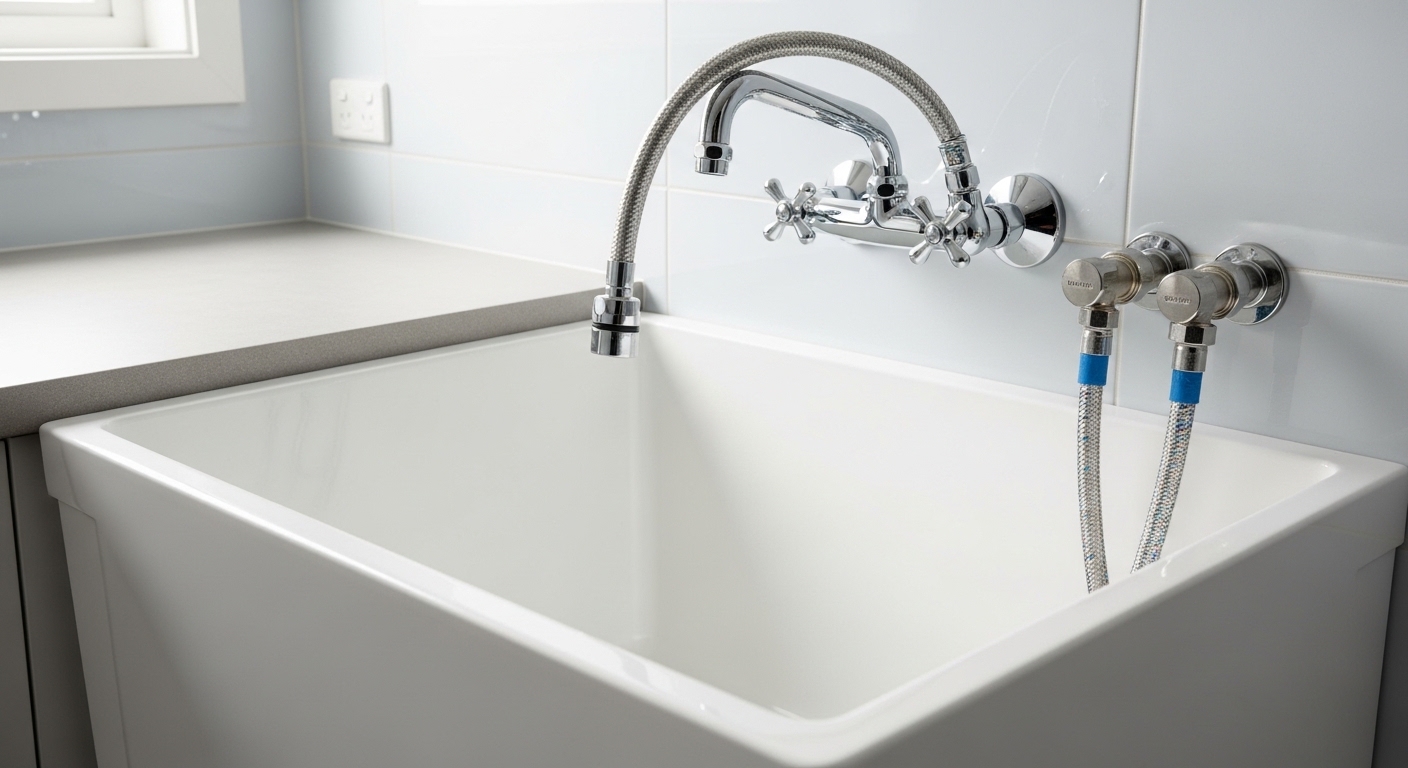
If you’ve ever stood in the hardware aisle wondering which laundry faucet home hardware actually matters — and which parts the store is just upselling you — you’re not alone. A laundry faucet isn’t the same as a kitchen or bathroom faucet. It lives in a rougher environment: mop buckets, work boots, dog baths, hose attachments, and a washing machine that slams the water on and off dozens of times a week. So the hardware you pick has to handle abuse that a delicate bathroom faucet never sees. Below, I’ll walk you through exactly what to buy, how the pieces fit together, and how to avoid the two or three mistakes that turn a 30-minute job into a weekend of leaks.
What exactly counts as “laundry faucet home hardware”?
Laundry faucet home hardware is the small group of plumbing parts that connect a utility faucet to your water supply and, often, to a washing machine. At minimum that’s the faucet body itself, the shutoff valves, the supply lines or braided hoses, and the threaded fittings that tie it all together. Everything else — brackets, escutcheon plates, thread tape, mounting screws — is supporting hardware.
Here’s the practical breakdown of what you’ll be handling:
- The faucet body — either wall-mounted (screws directly to threaded pipe stubs coming out of the wall) or deck-mounted (drops into holes drilled in a utility sink or countertop).
- Shutoff / supply valves — quarter-turn ball valves are the modern standard because they open and close with a 90° flick and rarely seize. Older homes have multi-turn compression stops.
- Washing-machine outlet box or hose bibbs — if the faucet feeds a washer, you’ll often see a recessed washer box with two lever valves and a drain standpipe.
- Braided stainless supply lines or rubber washer hoses — these carry water from the valve to the faucet or appliance.
- Fittings and adapters — 1/2″ FIP, 3/8″ compression, 3/4″ garden-hose thread (GHT). Getting these thread sizes right is where most people trip up.
The reason laundry hardware is built heavier than bathroom hardware comes down to duty cycle and torque. People crank laundry valves hard, hang hoses off the spout, and expect the faucet to survive being bumped by a laundry basket. That’s why solid brass and stainless dominate this category.
Wall-mount vs. deck-mount laundry faucet: which one do I need?
Pick a wall-mount faucet if your water pipes stick straight out of the wall above the sink, and a deck-mount faucet if your utility sink or counter has pre-drilled holes. That’s the whole decision in one sentence — the mount has to match where your water already comes from.
Wall-mount utility faucets are the most common in laundry rooms because builders rough in two threaded pipe stubs (hot and cold) at a standard 4-inch or 8-inch spread. The faucet’s inlet shanks thread right onto those stubs. Deck-mount faucets are what you’ll want if you bought a freestanding utility tub — like the deep plastic or acrylic ones — that has its own faucet ledge with 4″ centerset holes.
| Type | Best for | Typical spread | Install difficulty | Price range |
|---|---|---|---|---|
| Wall-mount utility faucet | Pipes exit the wall; laundry rooms, garages | 4″ or 8″ center-to-center | Easy (thread on) | $25–$70 |
| Deck-mount utility faucet | Freestanding utility tubs with faucet holes | 4″ centerset | Moderate | $40–$110 |
| Single-lever pull-down laundry faucet | Frequent rinsing, filling buckets | Single hole | Moderate | $60–$150 |
| Washer-box valve combo | Washing machine hookup + optional faucet | Recessed box | Advanced (may need wall access) | $30–$90 |
One measurement tip that saves a return trip: measure the center-to-center distance between your two pipe stubs before you buy. Utility faucets are sold as 4-inch or 8-inch spread, and they usually have a little adjustment (swiveling inlet couplers) to absorb a small mismatch — but not a two-inch one. If your stubs are an oddball distance, look for a faucet with adjustable “swing” inlets. If your supply line turns out to be the wrong length once you start, our guide on what to do when a faucet supply line is too short covers the exact adapters and extensions that fix it safely.
What material should a laundry faucet be — is plastic ever okay?
For a laundry faucet, choose solid brass or 304 stainless steel; skip all-plastic bodies unless it’s a truly light-duty, low-budget spot. Laundry faucets get manhandled, so material is the single biggest predictor of whether it survives five years or five months.
Here’s the honest tier list from someone who’s replaced a lot of these:
- Solid brass (best value): Heavy, corrosion-resistant, holds threads without stripping, and handles hot water without warping. This is what I recommend for 90% of laundry rooms.
- 304 stainless steel (best for looks + hygiene): Great if the faucet is visible or you’re in a hard-water or salty coastal area. It resists spotting and rust. If you go this route, our walkthrough on doing a 304 stainless steel faucet installation the right way is worth a read before you start.
- Zinc-alloy (budget, mixed): Fine for the faucet handle or trim, but zinc inlet threads can corrode and seize over time.
- All-plastic (light-duty only): Acceptable for a garage spigot you use twice a month, not for a daily laundry workhorse. The threads strip, and the spout cracks if it gets cold-snapped or hit.
Whatever material you choose, look for a spout with 3/4″ garden-hose thread (GHT) on the end. That single feature lets you screw a garden hose right onto the faucet for filling buckets, running water outside, or draining a fish tank — which is exactly what a laundry faucet is for.
Do I need special shutoff valves for a washing machine hookup?
Yes — for a washing machine you want quarter-turn ball valves, ideally a single-lever combo valve that shuts both hot and cold at once. Washers pull water in fast, and the sudden stop creates a pressure spike called water hammer that punishes cheap multi-turn valves. Quarter-turn ball valves close cleanly and are far less likely to drip or seize after years of sitting open.
A few valve-specific rules for laundry hardware:
- Use a single-lever dual valve if you can. It shuts both hot and cold with one flip — meaning you’ll actually turn the water off when the washer isn’t in use, which is the #1 way to prevent a burst-hose flood.
- Match the outlet to your washer hoses. Standard washer hoses use 3/4″ garden-hose thread. Most washer valves come with 3/4″ MHT (male hose thread) outlets, so a standard hose screws right on with a rubber washer inside.
- Replace rubber hoses with braided stainless. Old black rubber washer hoses are the single most common cause of laundry-room floods. Braided stainless-steel hoses cost a few dollars more and are burst-rated much higher.
If your laundry sink and washer share a wall, a recessed washing-machine outlet box keeps the valves and drain standpipe tidy and lets the hoses sit flush so the washer can push back against the wall. If you’re only feeding a utility sink (no washer), two simple quarter-turn angle stops under or behind the sink are all you need.
How much should laundry faucet home hardware cost in 2026?
A complete, quality laundry faucet hardware setup runs about $50 to $120 in 2026 — the faucet itself is $25–$80, a pair of quarter-turn valves is $10–$25, and braided supply lines add $10–$20. You do not need to spend $200+; laundry is the one room where mid-range hardware genuinely performs as well as premium.
Where it makes sense to spend a little more:
- The valves and hoses — this is what stands between you and a flooded floor. Buy quality here.
- A brass or stainless faucet body — the durability difference over plastic is worth the extra $15–$20.
Where you can save:
- Finish. A basic chrome or brushed-nickel laundry faucet performs identically to a designer finish. Nobody’s judging your utility sink’s aesthetics.
- Fancy spray modes. A single-stream or dual-mode spout is plenty; you don’t need a five-pattern kitchen sprayer back here.
If you’re weighing spending up vs. keeping it cheap across your whole home, our breakdown of luxury vs. budget faucets and what’s really worth your money in 2026 puts the laundry room in context — it’s exactly the spot where budget hardware shines. And if you’d rather buy in person and compare options first, where to find laundry taps near you and which one to actually buy is a good next stop.
How do I install a wall-mount laundry faucet myself?
You can install a wall-mount laundry faucet in about 30–45 minutes with a wrench, thread-seal tape, and a bucket — no plumber required for a like-for-like swap. The key is to shut the water off first and to seal the threads properly so the inlet joints don’t weep.
Here’s the short version of the process:
- Shut off the water at the laundry valves or the main, then open the old faucet to relieve pressure.
- Unthread the old faucet from the pipe stubs with a wrench, holding the pipe steady so you don’t twist it inside the wall.
- Clean the pipe threads and wrap them with 3–4 turns of PTFE (Teflon) thread-seal tape in the clockwise direction.
- Thread on the new faucet by hand first to avoid cross-threading, then snug it with a wrench. Use the swivel inlet couplers to align the faucet level.
- Turn the water back on slowly and watch every joint for drips for a full minute before you walk away.
The most common rookie mistake is over-tightening. Brass fittings seal on the tape and the mating surface, not on brute force — crank too hard and you can crack a coupler. Snug plus a quarter turn is the rule. Hard water is the other silent enemy here: mineral buildup clogs the aerator and stiffens the handle over time. If your spout output slows to a trickle after a year, our guide on removing hard water deposits from a faucet head will get the flow back without replacing anything.
Which thread sizes and fittings do I need to know?
The three thread sizes that cover almost every laundry faucet job are 1/2″ FIP (the pipe stub connection), 3/8″ compression (under-sink supply lines), and 3/4″ GHT (garden-hose thread for the spout and washer hoses). Mixing these up is the number-one reason a “quick” laundry project needs a second hardware-store trip.
| Fitting | Where it’s used | Thread type | Common pairing |
|---|---|---|---|
| 1/2″ FIP / MIP | Wall pipe stubs to faucet inlets | Tapered pipe thread (NPT) | Needs thread-seal tape |
| 3/8″ compression | Angle stops to supply lines | Straight, uses ferrule | Braided supply hose |
| 3/4″ GHT | Spout end + washer hose connections | Straight, uses rubber washer | Garden hose / washer hose |
| 1/2″ push-fit | Quick valve installs, no soldering | Push-to-connect | PEX or copper stubs |
A simple rule to keep them straight: tapered pipe threads (NPT) seal with tape or dope; straight threads (compression and hose) seal with a ferrule or a rubber washer. Never put thread tape on a garden-hose connection — the rubber washer does the sealing, and tape just gets in the way.
A quick note on quality, testing, and warranty
Not all laundry hardware is built to the same standard, and this is where a reputable brand matters even on a “cheap” faucet. Look for faucets that meet ASME A112.18.1 / CSA B125.1 (the North American standard for plumbing fixture fittings) and, if the water could ever be used for drinking or food, NSF/ANSI 61 for lead-safe wetted materials. A trustworthy manufacturer will also back the faucet with a warranty — many quality utility faucets carry a limited lifetime warranty on the finish and function, which tells you they’ve pressure-tested the cartridge and valve seats to survive years of hard use.
FAQ
Can I use a regular kitchen faucet as a laundry faucet?
You can, but it’s usually the wrong tool. Kitchen faucets rarely have a garden-hose-thread spout, so you can’t screw a hose on to fill buckets — which is the main reason to have a laundry faucet. A dedicated utility faucet is also built tougher and costs less. Use a kitchen faucet only if you want a nicer look and don’t need hose attachment.
Do I need both hot and cold for a laundry faucet?
For a utility sink alone, cold-only is fine if you just rinse and fill buckets, but a hot-and-cold faucet is far more useful for hand-washing, cleaning, and pretreating stains. For a washing machine, you almost always need both hot and cold hookups because the washer mixes them for different wash temperatures.
What’s the difference between a laundry faucet and a washer outlet box?
A laundry faucet delivers water to a sink through a spout you turn on and off manually. A washer outlet box is a recessed wall box with two lever valves and a drain standpipe that connects your washing machine hoses. Many laundry rooms have both — a faucet over the utility sink and an outlet box for the washer — but they serve different jobs.
Why does my laundry faucet drip even when it’s fully off?
A laundry faucet that drips when shut off almost always has a worn cartridge, washer, or valve seat — the internal part that presses closed to stop the flow. Hard-water grit and constant use wear it down. It’s a cheap fix: replace the cartridge or stem washer rather than the whole faucet. If the drip is at the base or inlet instead of the spout, re-tape and re-seat the threaded connection.
Should I turn off my laundry faucet valves when I’m not doing laundry?
Yes, especially for a washing machine. Leaving supply valves open keeps the hoses under constant pressure, and a burst hose is one of the most common causes of home water damage. A single-lever dual shutoff valve makes this a one-second habit — flip it off when you’re done, flip it on for the next load.
Can I install laundry faucet hardware without soldering?
Absolutely. Modern push-to-connect (push-fit) valves and threaded or compression fittings let you build an entire laundry faucet setup with zero soldering. For a like-for-like faucet swap onto existing threaded pipe stubs, you only need a wrench and thread-seal tape. Soldering only comes into play if you’re running brand-new copper supply lines.
Author note: This guide was written by the WOWOW Faucet product team, drawing on hands-on installation and testing of utility and laundry faucets across brass, stainless, and zinc-alloy builds. WOWOW designs and sells faucets and bathroom fixtures direct to homeowners, and every fixture we ship is built to meet North American plumbing standards and backed by a limited warranty. Our goal here is simple: help you buy the right laundry faucet home hardware once, install it in an afternoon, and never think about it again.
您好!Sign In