 WOWOW Faucets
Delta Pull Down Kitchen Faucet Parts: The Complete 2026 Replacement & Repair Guide
View Count:264 CategoryProduct
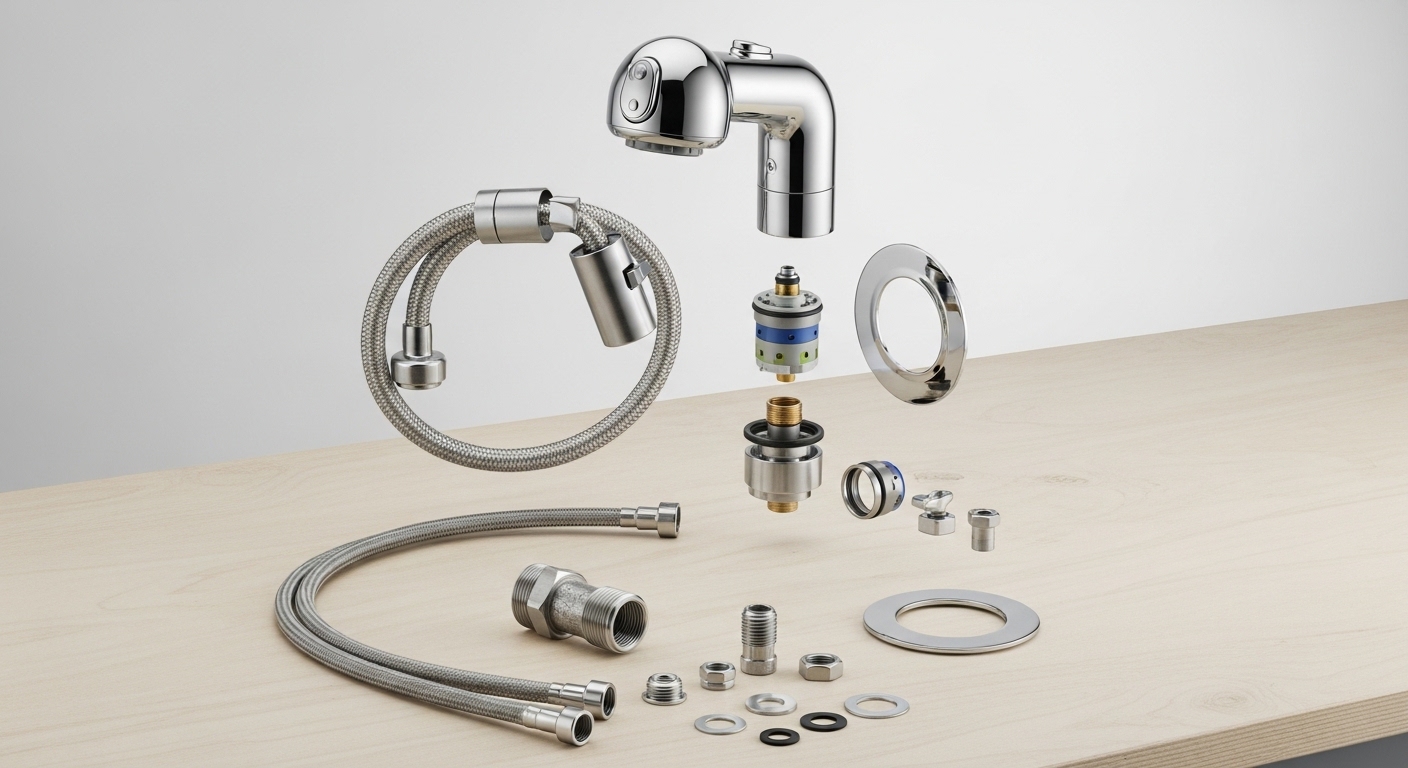
If you searched for delta pull down kitchen faucet parts, you are almost certainly trying to fix a leak, restore weak spray pressure, or replace a worn pull-down hose without paying for a brand-new faucet. The good news: nearly every Delta pull-down model from the last decade is engineered around modular, user-serviceable components, and most repairs take 20 to 45 minutes with basic tools. The trickier news: Delta produces dozens of model families — Leland, Trinsic, Essa, Cassidy, Lenta, Mateo, Coranto, Allentown — and the parts are not always cross-compatible. Picking the wrong cartridge or spray wand kills the repair before you start.
This guide is written for homeowners and contractors who want a clear, conversion-focused breakdown of every component inside a Delta pull-down kitchen faucet, how to verify the part you need, and where pricing usually lands in 2026. We will also flag where third-party alternatives (including our own WOWOW pull-down models and universal replacement parts) make sense — and where they absolutely do not.
Why Delta Pull Down Kitchen Faucet Parts Matter More Than the Faucet Body
The cast brass body of a Delta pull-down kitchen faucet — the visible spout, hub, and base — almost never fails. What fails are the moving and sealing components inside it. Understanding the catalog of replaceable delta pull down kitchen faucet parts means you treat your faucet as a long-term fixture rather than a disposable appliance. A $25 cartridge or $40 spray wand can give a 10-year-old faucet another decade of service, which is exactly why Delta backs its pull-downs with a Lifetime Limited Warranty on the finish and function for residential users.
That warranty, by the way, is one of the strongest in the industry — but it only applies to original purchasers with proof of purchase, and labor is not covered. So even under warranty, the actual swap-out work is yours. The parts below are the ones you will encounter again and again.
The Core Components Inside Every Delta Pull-Down
- Spray wand (pull-down head): The grip you pull down. Houses the spray/stream toggle and aerator.
- Pull-down hose: A braided PEX or nylon-jacketed hose, typically 59″ to 68″ long, with quick-connect fittings on both ends.
- Counterweight (W-shaped or barrel): Snaps onto the hose under the sink and pulls the wand back into the dock.
- Cartridge: Delta uses DIAMOND Seal Technology cartridges (RP50587, RP25513, RP47422 and variants) in most modern pull-downs.
- Diverter assembly: Routes water between the spout aerator and the spray wand on dual-flow models.
- O-rings and seals: Small rubber rings around the spout base and inside the spray head — the #1 cause of slow drips.
- MagnaTite docking magnet: The neodymium magnet that snaps the wand back into place on Touch2O and ShieldSpray models.
- Touch2O solenoid (electronic models only): The valve that opens when you tap the spout.
- Aerator / spray plate: The grey rubber face on the wand — easily replaceable when it clogs with limescale.
- Mounting hardware: Studs, washers, lock nuts, escutcheon plate, and the deck gasket.
How to Identify Your Exact Delta Pull-Down Model
Before you buy a single part, you need the model number. Delta hides this in three places, in order of reliability:
- The original installation manual or the box (start here if you still have it).
- A laser-etched code on the spout neck or under the handle — usually a 4-digit number prefixed by “Series.”
- The shape of the spout combined with the handle position — Delta’s product configurator at deltafaucet.com lets you visually match it.
The model family matters because, for example, a Leland cartridge is not the same as a Trinsic cartridge, and a Cassidy spray wand has a different thread on the hose connector than an Essa. Cross-referencing the original SKU (e.g., 9178-AR-DST or 19922Z-SSSD-DST) gives you the exact part-number set. If you are between repairs and considering a full replacement, our team has covered the broader decision in our guide on how to tell if your faucet needs replacing — well worth a five-minute read before you spend money on parts for a faucet that is genuinely at end-of-life.
The Most Common Delta Pull Down Kitchen Faucet Parts to Replace
1. Spray Wand (Pull-Down Head)
The spray wand is the part that takes the most abuse. Hard water clogs the spray face, the toggle button sticks, and after about five years of daily use the internal flow restrictor begins to whistle. Genuine Delta replacement wands ship under SKUs like RP62057, RP70114, RP72107, and RP100061 — each tied to a specific finish (Arctic Stainless, Chrome, Matte Black, Champagne Bronze, SpotShield Stainless, Lumicoat). You absolutely must match the finish code, because Delta will not accept a return on a mismatched wand.
Typical 2026 pricing: $38–$95 from authorized resellers. Aftermarket “universal” wands exist for under $20, but they are rarely true 1:1 fits — the magnet polarity for MagnaTite docking is often wrong, which means your wand will dangle instead of snap home.
2. Pull-Down Hose
The hose is the second most-replaced component, especially on faucets installed more than seven years ago where the nylon braid begins to fray near the cartridge body. Delta’s quick-connect hose assemblies (RP50390, RP44647, RP46074) are color-coded white at the wand end and have a push-button quick-connect collar at the valve body end — no tools required to swap them out. Length matters: standard kitchen pull-downs use a 59″ hose; bar faucets and prep faucets use a shorter 32″–40″ version.
3. DIAMOND Seal Cartridge
This is the heart of every Delta single-handle pull-down. The DIAMOND Seal cartridge uses a diamond-embedded ceramic disc that Delta claims lasts up to 5 million uses — roughly twice the industry standard. When you have a drip from the spout or the handle gets stiff, the cartridge is almost always the culprit. Most pull-downs use RP50587, but verify against your model number. The cartridge swap is a 15-minute job: shut off the supply, pop the handle, unscrew the bonnet, lift the old cartridge straight up, drop the new one in, and reverse.
4. Counterweight
If your spray wand will not retract fully into its dock, 90% of the time the counterweight has slipped down the hose. The fix is free — slide it back up to the manufacturer-marked position, usually 12″–14″ below the deck. If the weight itself is missing or cracked, RP70171 (barrel-style) and RP46073 (W-clip style) are the standard replacements. Around $14–$22.
5. O-Rings, Seats & Springs
The classic “puddle around the base” leak is almost always caused by dried-out O-rings on the spout sleeve. Delta sells the repair kit as RP4993 or RP25513 for two-handle widespread variants. For dripping spouts on older non-DIAMOND-Seal models, RP4993 also includes the rubber seats and springs that sit beneath the ball assembly.
Delta Pull-Down Parts vs. Third-Party Alternatives: An Honest Comparison
Should you always buy genuine Delta parts? Not necessarily. Here is how the three main paths actually compare in 2026:
| Part Source | Price Range | Warranty Honored? | Fit Accuracy | Best For |
|---|---|---|---|---|
| Genuine Delta (RP-series) | $$$ (full retail) | Yes, fully | 100% — exact fit | Faucets under 5 years old, finish-critical visible parts |
| OEM-equivalent (e.g., DANCO, Plumb Pak) | $$ (30–50% less) | No — voids Delta warranty on the part | 95%+ for cartridges, O-rings | Internal parts you’ll never see |
| Universal aftermarket (Amazon/eBay generic) | $ (cheapest) | No | 60–80% — hit or miss | Aerators, spray plates, counterweights only |
| Full faucet upgrade (e.g., WOWOW pull-down) | $$$ (~$140–$280) | New warranty starts | N/A — new system | Faucets 10+ years old with multiple failures |
The honest rule of thumb: buy genuine Delta for any visible finished part (spray wand, escutcheon, handle) so the finish matches your existing fixture. Buy OEM-equivalent for cartridges, O-rings, and hoses — the savings are real and the fit is reliable. Skip universal aftermarket entirely for anything that holds pressure.
Step-by-Step: Replacing the Most-Failed Delta Parts
Swapping the Pull-Down Hose
- Shut off both hot and cold supply valves under the sink. Open the faucet briefly to relieve pressure.
- Slide the counterweight off the hose (squeeze the spring clip; it should release in one motion).
- Unscrew the spray wand from the hose at the deck level. Hand-tight only — no wrench needed.
- Press the quick-connect collar at the valve body and pull the old hose down through the spout.
- Feed the new hose up through the spout, snap the quick-connect into the valve body, reattach the wand, and clip the counterweight back on at the marked position.
- Turn supplies on, run for 30 seconds with the aerator removed to flush any debris, then reinstall the aerator.
If you are also dealing with finicky supply connections beneath the sink, we have a full walkthrough on how to connect faucet hoses to shutoff valves that covers compression fittings, braided supply lines, and the right torque to avoid crushing the ferrule.
Replacing the DIAMOND Seal Cartridge
- Shut off the water and remove the decorative handle cap (a flathead pries it out).
- Loosen the set screw with a 7/64″ hex key — do not remove it fully, just loosen.
- Lift the handle straight up and off.
- Unscrew the bonnet nut by hand (newer models) or with channel-lock pliers wrapped in tape (older models).
- Pull the cartridge straight up. Note the alignment notch — the new one must go in the same orientation.
- Drop the new cartridge in, hand-tighten the bonnet, reinstall the handle, and turn on the water slowly.
If the old cartridge is stuck — and they often are after 8+ years — do not pry sideways or you will crack the brass body. Our guide on how to fix a stuck faucet cartridge with lubrication and removal hacks covers the white-vinegar soak and cartridge-puller approach that has saved countless faucets.
Clearing a Clogged Spray Wand
Before you replace the entire wand, try cleaning it. Unscrew the wand from the hose, soak the spray face in a 50/50 white vinegar/water solution for 30 minutes, then scrub the rubber nozzles gently with a toothbrush. About 60% of “weak spray” complaints resolve at this step. If flow is still uneven, the internal flow restrictor or the aerator screen behind the wand is the next stop — our walkthrough on how to unclog a kitchen faucet aerator applies almost identically to pull-down wands.
Touch2O and VoiceIQ: Special Parts Considerations
If your Delta pull-down has Touch2O (capacitive touch activation) or VoiceIQ (Alexa/Google integration), there are two parts you will not find on a standard pull-down: the solenoid valve and the control box. Both run on a 6V DC supply, either from six AA batteries or an optional AC adapter (EP73954).
Solenoid Symptoms and Replacement
A failing solenoid manifests as: water that runs but won’t shut off when you tap, the LED at the base of the faucet blinking red, or the faucet behaving normally with the handle but ignoring touch input. The solenoid (EP74852 or EP100503 depending on year) lives in a small black box under the sink, connected by a single ribbon cable. Swap is about 20 minutes — disconnect both supply lines from the solenoid, screw the new one in place, reconnect, and the system auto-calibrates on the next handle cycle.
Battery Pack vs. AC Adapter
The factory battery pack lasts 12–24 months for an average household. If you are tired of changing batteries, the EP73954 AC adapter is a one-time $35 fix that plugs into a standard outlet under the sink. Worth every penny.
Finish Matching: The Hidden Gotcha
Delta uses finish codes that look almost identical but are not interchangeable. The most common are:
- DST — Chrome
- SS / SSSD — Stainless / SpotShield Stainless
- AR — Arctic Stainless
- BL — Matte Black
- CZ — Champagne Bronze
- RB — Venetian Bronze
- KS — Black Stainless
- PN — Polished Nickel
Always verify the suffix on your original SKU before ordering a spray wand, handle, or escutcheon. The finishes are PVD-coated and electroplated to slightly different specs, so a “Chrome” wand on a “Polished Nickel” body is immediately visible — even to a non-design-eye. If you’re weighing finishes for a future kitchen refresh, our deep dive on polished chrome vs. satin nickel differences breaks down how each finish ages and which holds up best around hard water.
When to Stop Buying Parts and Replace the Whole Faucet
There comes a point — usually around the 12-year mark — where pouring money into individual delta pull down kitchen faucet parts stops making financial sense. Watch for these signals:
- You have replaced the cartridge twice in 18 months (the brass body is likely scored).
- The base of the spout shows visible corrosion or pitting under the finish.
- You can no longer source the original spray wand finish (Delta retires SKUs after about 15 years).
- Total parts spend in 24 months exceeds 60% of a new faucet’s price.
- The faucet uses pre-DIAMOND-Seal ball-valve technology (pre-2010) — every modern repair is a downgrade.
At that point, a full replacement with a modern pull-down — whether you stay with Delta or move to a brand like WOWOW that uses standard 1/4-turn ceramic disc cartridges and universal hose fittings — usually pays for itself in two years through eliminated drip waste alone. To get a sense of just how much that drip is costing you, see how much water a dripping faucet actually wastes.
Where to Buy Genuine Delta Parts (and Avoid Counterfeits)
Counterfeit Delta parts are a real and growing problem, especially on third-party marketplaces. To stay safe:
- Buy from deltafaucet.com directly, or from authorized resellers (Ferguson, Build.com, Lowe’s, Home Depot, Amazon “Ships from and sold by” Delta or these retailers).
- Genuine Delta parts ship in branded blue-and-white packaging with a holographic seal.
- Genuine RP-series part numbers are laser-etched into the part itself, not stickered.
- If the price is more than 40% below MSRP, assume counterfeit until proven otherwise.
About the WOWOW Position on Delta Parts
WOWOW Faucet is a U.S.-based bathroom and kitchen fixtures brand — every faucet we sell ships with cUPC, NSF/ANSI 61, and CALGreen certification, and our pull-down hoses are independently pressure-tested to 500 PSI (well above the 60 PSI residential standard). We are not a Delta reseller. What we are is a brand that has installed and serviced more than 100,000 kitchen faucets in North American homes, so we know exactly where the Delta lineup shines and where homeowners get frustrated. When a Delta repair makes sense, we will tell you so. When you’re better off replacing with a comparably-spec’d WOWOW pull-down at a lower price point, we will tell you that too.
FAQ
Are all Delta pull down kitchen faucet parts interchangeable across models?
No. While many internal parts like O-rings and some cartridges cross over, spray wands, hoses, and escutcheons are model-specific. Always verify by your original Delta SKU (e.g., 9178-AR-DST) before ordering a part. The RP-series part number on the Delta website’s parts diagram is the only reliable cross-reference.
How long should a Delta pull-down hose last?
A genuine Delta nylon-braided pull-down hose typically lasts 8–12 years under normal residential use. Hard water, hot water above 140°F, and aggressive cleaning chemicals all shorten lifespan. If you see fraying near the wand end or feel kinks that don’t straighten out, replace it — a failed hose under the sink can dump 1–2 gallons per minute into your cabinet.
Can I use a third-party cartridge in my Delta pull-down without voiding the warranty?
Technically, yes — Delta’s warranty covers the faucet, not the parts you’ve replaced. But using a non-Delta cartridge means that specific part is no longer covered, and if it damages the brass body, Delta may deny a warranty claim on the body itself. For peace of mind, use genuine Delta cartridges (RP50587 and family); the price difference over an OEM-equivalent is rarely more than $10.
Why does my Delta spray wand keep dangling instead of snapping into place?
This is the MagnaTite docking magnet. Either (a) the counterweight on the hose has slipped down — slide it back up to the marked position, or (b) a piece of steel debris (a paperclip, a twist tie) is stuck to the magnet inside the spout. Pull the wand all the way out, look up into the spout neck, and clear the magnet face. If the magnet itself has cracked (rare, but it happens after a heavy impact), the spout assembly typically needs replacement rather than the magnet alone.
Does Delta sell replacement aerators for pull-down spray wands?
Yes — though they’re technically called “spray faces” on a pull-down. The rubber nubbed surface unscrews from the front of the wand (some models require a Delta-supplied removal key, others are hand-removable). Part numbers vary by wand model. Before replacing, try soaking the spray face in white vinegar for 30 minutes to dissolve mineral buildup — that fixes the issue 60% of the time at zero cost.
What’s the best upgrade if my Delta pull-down is more than 10 years old?
If you’ve already replaced the cartridge and hose, and the spray wand finish is showing wear, a full faucet swap is almost always more cost-effective than continued parts repair. Modern pull-downs (whether Delta, Moen, Kohler, or WOWOW) deliver better flow regulation, quieter operation, and meet 2026 WaterSense efficiency standards. Expect to spend $150–$350 for a quality residential pull-down with a lifetime cartridge warranty.
Can I install Delta replacement parts myself, or do I need a plumber?
Nearly every part swap covered in this guide — cartridge, hose, spray wand, counterweight, aerator, O-rings — is a 15-to-45 minute DIY job with basic hand tools. The exceptions are Touch2O solenoid replacements (still DIY-friendly but involves the electrical side) and any repair where the brass body itself is damaged. A licensed plumber typically charges $150–$250 for these repairs, so DIY savings are substantial.
Author Note & Editorial Standards
This guide was written and fact-checked by the WOWOW Faucet editorial team, drawing on hands-on installation and warranty-claim data from more than 12 years of supplying residential kitchen and bath fixtures across the U.S. market. All cartridge longevity figures reference manufacturer-published test cycles (ASME A112.18.1 / CSA B125.1). All flow-rate references comply with the EPA WaterSense 1.8 GPM kitchen faucet standard effective 2026. Pricing reflects U.S. MSRP at time of publication and is subject to change. WOWOW products are independently certified to NSF/ANSI 61 (drinking water safety), NSF/ANSI 372 (lead-free compliance), and carry a Lifetime Limited Warranty on cartridges and finish for residential installations.
您好!Sign In