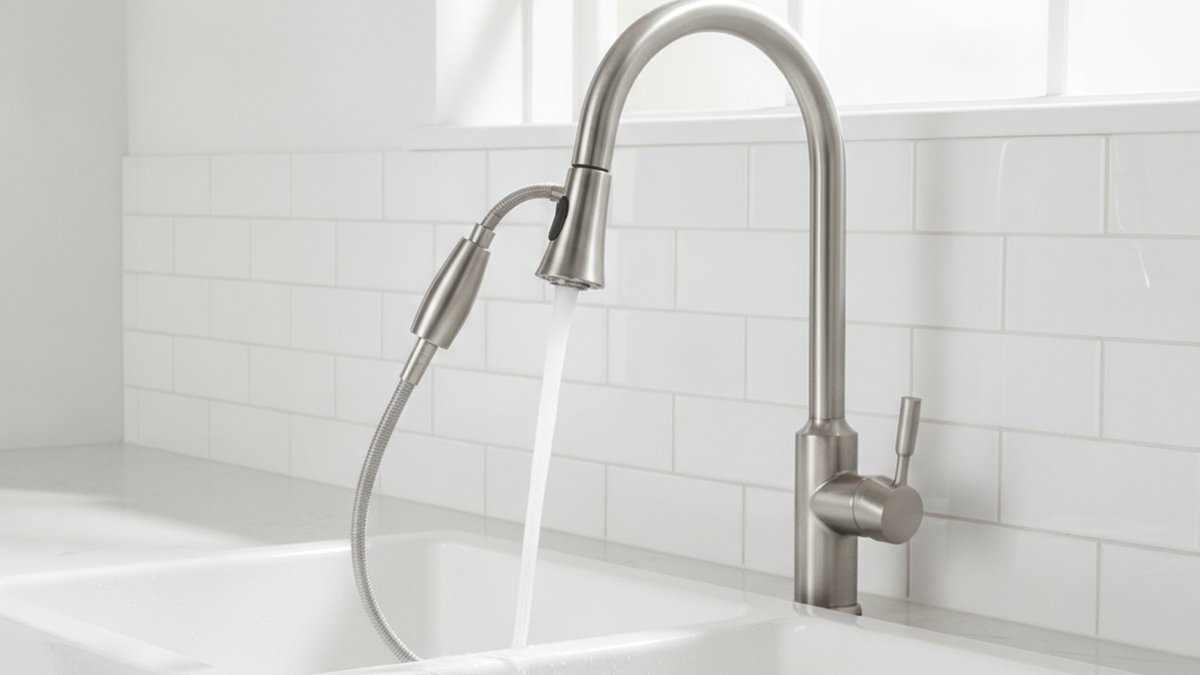
If you’ve been searching for a wall mounted faucet kitchen with pull out spray, you’re probably staring at a sink where the counter behind it is either cramped, hard to clean, or sitting against a window with no room for a tall faucet. Wall-mounting solves that by moving the whole faucet body off your countertop and onto the wall, while the pull-out spray gives you the reach and flexibility to rinse dishes, fill pots on the counter, and wash down the whole basin. Below, I’ll walk you through exactly who this faucet is right for, the rough-in measurements you can’t skip, what to look for when buying, and how it compares to a standard deck-mount pull-out — in plain language, from someone who’s installed and troubleshot a lot of these.
What exactly is a wall mounted kitchen faucet with a pull-out spray?
It’s a kitchen faucet whose body bolts to the wall behind the sink instead of sitting on the countertop or sink deck, and whose spout houses a spray head you can pull out on a flexible hose. So instead of water lines coming up through holes in your counter, they come out of the wall, and the spout arcs out over the basin from that wall connection.
That combination gives you two wins at once. First, nothing sits on the counter behind the sink — no faucet base, no soap-dispenser hole clutter, no gunk collecting around a deck plate. Second, the pull-out spray means the aerator detaches from the spout and extends 20–30 inches on a hose, so you can direct water anywhere in the sink, rinse a sheet pan, or fill a stockpot that won’t fit under the spout. It’s the same spray flexibility you’d get from a good deck-mount pull-out, just fed from the wall.
People most often want this setup for one of three reasons: a farmhouse or apron-front sink where the faucet looks better rising from the wall, a sink under a window with no vertical room for a tall gooseneck, or a clean, minimalist kitchen where an empty counter behind the sink is the whole point.
Is a wall mounted kitchen faucet actually better than a deck-mount pull-out?
Better for cleaning and looks, harder to install and repair — that’s the honest trade-off. A wall-mount keeps your countertop completely clear, so wiping crumbs and water off the counter is a two-second swipe with nothing to work around. It also frees up the space a deck-mount base would occupy, which matters a lot with shallow counters or a sink pushed close to a window.
The catch is the plumbing. A deck-mount faucet uses supply lines you can reach under the sink, and swapping one out is a 30-minute job. A wall-mount’s supply lines and mounting are inside the wall, so getting the rough-in right at build time is critical, and any future repair may mean opening the wall. If you’re doing a full remodel or new construction, that’s a non-issue — you plan for it. If you’re retrofitting into a finished wall with plumbing that already comes up through the floor, converting to wall-mount is a real project.
Here’s a quick side-by-side to make the decision concrete:
| Factor | Wall Mounted Pull-Out | Deck-Mount Pull-Out |
|---|---|---|
| Counter cleanup | Easiest — nothing on the counter | Have to wipe around the base |
| Install difficulty | Hard — needs in-wall rough-in | Easy — connects under the sink |
| Best for | Farmhouse/apron sinks, sinks under windows, remodels | Any standard sink, quick upgrades |
| Future repair | May require opening the wall | Access from under the sink |
| Freeze risk (exterior wall) | Higher — lines sit in the wall | Lower — lines are inside the cabinet |
| Typical price range | $120–$400+ | $80–$350+ |
One point worth flagging: if the faucet mounts on an exterior wall in a cold climate, the supply lines sitting inside that wall can be a freeze risk. Insulation behind the pipes helps, but it’s a reason many people keep wall-mount faucets on interior walls.
What rough-in height and spacing do I need for a wall mounted kitchen faucet?
The faucet outlet should sit about 8 to 10 inches above the sink rim, and the two supply stub-outs are almost always spaced 8 inches apart on center — but always confirm the exact numbers against your specific faucet’s spec sheet before the plumber closes the wall. Getting this wrong is the single most common regret with wall-mount faucets.
Here’s what actually matters when you rough in:
- Height above the sink: Mount too low and the spout crowds the basin; too high and water splashes. Aim for the spout base roughly 8–10 inches above the finished sink rim, adjusted for how deep your sink is and how tall your pots are.
- Center-to-center spacing: Most wall-mount kitchen and utility faucets use 8-inch centers between the hot and cold connections. Some bridge and utility styles differ, so match the faucet you’re actually buying.
- Horizontal centering: Line the faucet up with the center of the sink basin, not the center of the cabinet — those aren’t always the same.
- Reach/spout length: Make sure the spout reaches far enough out and down that water lands in the drain area, not the front lip of the basin.
- Backing: Add solid blocking or a mounting bracket in the wall so the faucet body has something firm to bolt to, not just drywall.
Because wall connections don’t line up the way a deck faucet does, it’s worth reading up on hole spacing generally before you commit — the same “measure twice, drill once” logic that applies to a standard bath tap hole size applies here, just on the wall instead of the deck. And if your existing supply lines don’t reach the new wall location, that’s a solvable but real problem — the same one people hit when a faucet supply line is too short — and it’s far easier to fix before the wall is closed up.
How hard is it to install a wall mounted pull-out kitchen faucet myself?
If the wall is already roughed in with connections at the right height and spacing, a confident DIYer can install one in an afternoon; if you’re starting from a wall with no plumbing there, that’s a job for a plumber. The difference is whether you’re doing finish work or opening walls and running pipe.
For the finish install on a roughed-in wall, the basic sequence looks like this:
- Shut off the water at the stops or the main, and open a faucet to relieve pressure.
- Confirm your stub-outs match the faucet’s inlet spacing and thread type; add adapters if needed.
- Attach the faucet’s inlet connections to the wall supplies, using thread sealant or the supplied washers exactly as the instructions specify.
- Mount the faucet body to the in-wall bracket or blocking and level it.
- Route the pull-out hose and connect the spray head; hang the weight if the model uses one for retraction.
- Fit the escutcheon/trim plate against the wall to cover the openings.
- Turn the water back on slowly and check every joint for leaks before you walk away.
The parts people underestimate are leveling (a wall-mount that’s slightly off looks obviously crooked) and sealing the trim against the wall so water doesn’t sneak behind it. If you’re comfortable with basic plumbing connections — the same skill set you’d use to fix a leaky kitchen sink faucet — the finish install is manageable. If words like “rough-in,” “stub-out,” and “in-wall backing” make you nervous, get a pro for the plumbing and save your energy for picking the finish.
What should I look for when buying one under $300?
Under $300, prioritize a solid brass or stainless body, a ceramic disc cartridge, a braided (not plastic) pull-out hose, and a magnetic or well-tensioned spray dock that snaps the head back into place. Those four things separate a faucet that lasts a decade from one that drips and sags in two years.
Run down this checklist before you buy:
- Material: A brass or stainless steel body resists corrosion far better than zinc alloy. This is the same reason people pay up for a brass bathtub faucet — the metal simply outlasts the cheap stuff.
- Cartridge: A ceramic disc valve gives you smooth, drip-free control for years and is the part most likely to determine whether you’ll be doing repairs.
- Spray head and modes: Look for at least a stream/spray toggle, a comfortable trigger or button, and a nozzle you can wipe clean (rubber spray tips resist mineral buildup).
- Hose and retraction: A nylon-braided hose and a good docking magnet keep the spray head from drooping over time — a droopy head is the number-one long-term complaint with pull-outs.
- Flow rate: Most quality faucets run 1.5–1.8 GPM. Look for a WaterSense label if efficiency matters to you.
- Finish: Match your hardware and think about maintenance — spot-resist/brushed finishes hide water marks better than polished chrome.
- Certifications: Check for cUPC and NSF/ANSI 61 and 372 (lead-free) listings, which tell you the faucet is built to recognized plumbing and drinking-water safety standards.
One finish tip: if you’re pairing the faucet with a dark or two-tone kitchen, the same logic that makes a black kitchen faucet with white cabinets work applies to wall-mounts — contrast reads as intentional, and a wall-mount’s clean lines make that contrast even sharper.
What are the downsides nobody mentions?
The three real downsides are harder repairs, splashing if the height is wrong, and freeze risk on exterior walls — all manageable, but worth knowing before you buy. None of these are dealbreakers for the right kitchen, but they’re the things people wish they’d heard first.
Repairs top the list. Because the valve and connections live in the wall, a failed cartridge or a leak at the inlet can mean cutting into drywall. Buying a faucet with a serviceable cartridge and a reputable warranty softens this a lot, but it’s the price of the clean look. Splashing is second: if the outlet sits too high over a shallow sink, water bounces off the basin and onto the counter or you. That’s a rough-in decision, which is exactly why the height numbers above matter so much. And on an exterior wall in a freezing climate, water sitting in an uninsulated wall cavity can freeze and burst — so keep these on interior walls where you can, or insulate carefully.
The good news: every one of these is a planning problem, not a fundamental flaw. Nail the rough-in height, keep it on an interior wall, and buy a faucet with a good cartridge and warranty, and a wall-mount pull-out will serve you for years while looking far cleaner than a deck-mount ever could.
FAQ
Can I convert my existing deck-mount sink to a wall mounted faucet?
Yes, but it’s a real project, not a swap. You’ll need to run new supply lines up the wall to the correct rough-in height and spacing, add in-wall backing for the faucet body, and cap or cover the old deck holes. If the wall behind your sink is finished, expect to open it up. It’s very doable during a remodel; as a standalone weekend job, it’s ambitious.
What height should a wall mounted kitchen faucet be above the sink?
Plan for the spout outlet to sit roughly 8 to 10 inches above the finished sink rim, adjusted for how deep your basin is and how tall your typical pots are. Deeper sinks can go a bit higher without splashing; shallow sinks should stay lower. Always check your specific faucet’s spec sheet, since spout arc and reach vary by model.
Do wall mounted kitchen faucets leak more than deck-mount ones?
They don’t leak more inherently — a quality faucet with a ceramic cartridge and proper connections is just as reliable. The difference is that if a wall-mount does leak, the connections are inside the wall, so a leak can go unnoticed longer and is harder to reach. Good sealing at install and a serviceable cartridge are your best protection.
What size spray hose comes with a wall mounted pull-out faucet?
Most pull-out spray hoses give you about 20 to 30 inches of extension, which is plenty to reach every corner of a standard sink and fill a pot on the counter. If your current sprayer feels short or stiff, that’s usually a hose or docking issue — the same fix that helps a short, stiff pull-out sprayer applies here.
Are wall mounted kitchen faucets good for farmhouse sinks?
They’re one of the best pairings, yes. An apron-front farmhouse sink sits proud of the counter, so a faucet rising cleanly from the wall above it looks intentional and keeps the wide sink deck clear. Just make sure the spout reaches far enough out to land water past the apron and into the basin.
How much does a wall mounted kitchen faucet with pull out spray cost?
Expect roughly $120 to $400 for a quality wall-mount pull-out from a reputable brand, with most solid mid-range options landing around $150–$250. Below about $120 you start seeing zinc bodies and plastic hoses that won’t last; above $400 you’re usually paying for designer finishes and premium brands rather than better function.
Author note: This guide was written by the product team at WOWOW Faucet, drawing on hands-on installation and testing of kitchen and bath fixtures. WOWOW designs faucets built to recognized cUPC and NSF/ANSI lead-free standards and backs them with a manufacturer warranty, so the specs and advice here reflect what we actually test and stand behind — not marketing copy. Always follow your local plumbing code and your faucet’s included instructions, and when in doubt about in-wall work, consult a licensed plumber.