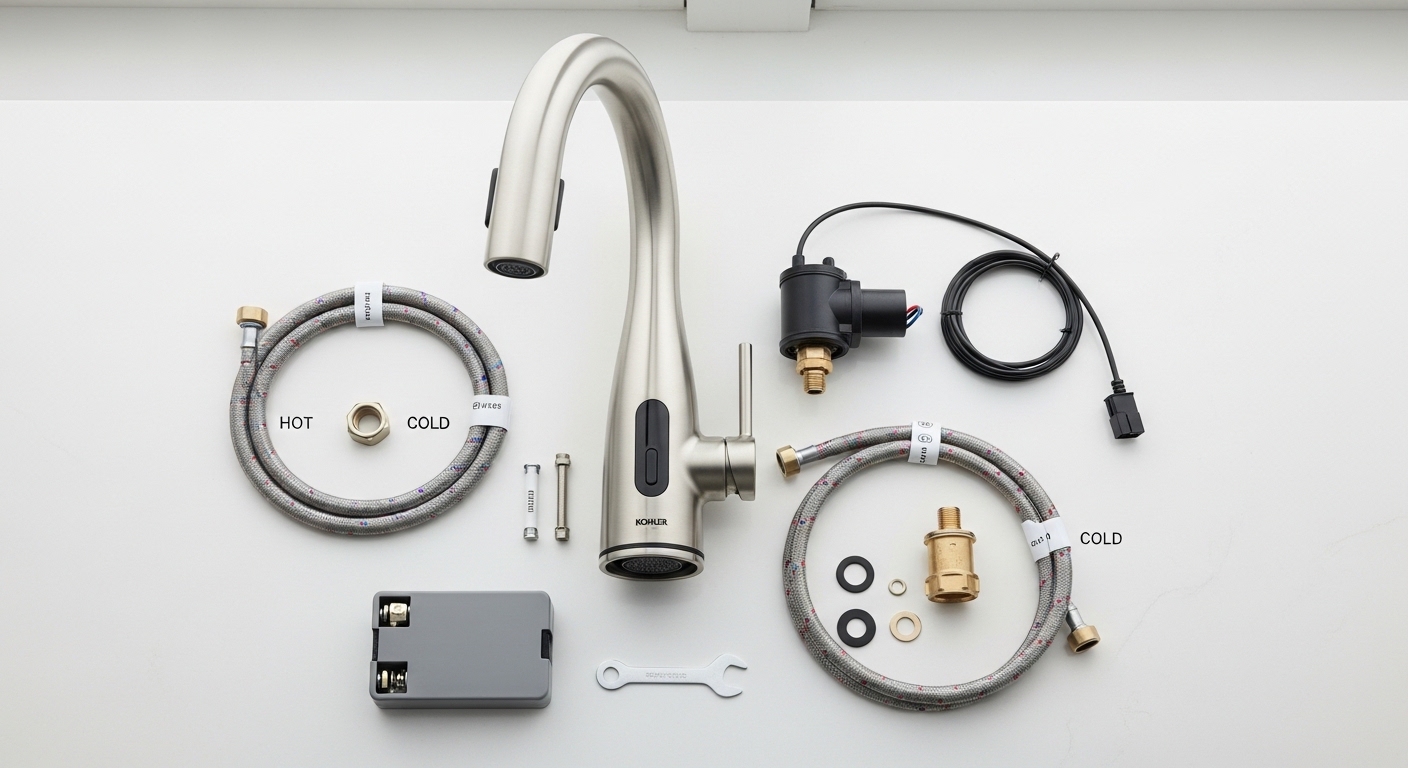
If you’ve just bought a Kohler Sensate, Malleco, or Setra, a Kohler touchless faucet installation is genuinely one of the more approachable “smart” upgrades in a kitchen. The wave-to-start sensor sounds high-tech, but under the sink it’s really just a standard faucet plus two extra pieces: a solenoid valve (the electronic “on/off” gate for the water) and a sensor cable that talks to it. Get those two things seated correctly and the rest is the same plumbing you’d do on any pull-down faucet. Below I’ll walk through exactly what’s in the box, the step-by-step install, the mistakes that cause 90% of the “my touchless faucet won’t turn on” support calls, and how to power it so the battery doesn’t die in six months.
What comes in the box, and what tools do you actually need?
Every Kohler touchless kitchen faucet ships as a complete kit — you don’t buy the sensor separately. Inside you’ll find the faucet body, the pull-down spray head and hose, a solenoid valve, a battery pack (Kohler uses 6 AA on most Sensate models, some use C cells), a sensor cable, a mounting nut and base plate, and two pre-attached or included supply hoses. What Kohler does not include are your under-sink shutoff valves or the AC adapter (sold separately as the Kohler K-1039883 power adapter).
Here’s the honest tool list. You don’t need anything exotic:
- Basin wrench — the one tool that turns this from a nightmare into a 10-minute job when reaching the mounting nut behind the sink.
- Adjustable wrench or a set of pliers for the supply-line connections.
- A bucket and towel (there’s always leftover water in the lines).
- Plumber’s tape (Teflon tape) for any threaded metal connections.
- A flashlight or headlamp — under a sink is dark.
- Fresh batteries, or the optional AC adapter if you have an outlet under the sink.
If your existing shutoff valves are corroded or you don’t have any, that’s the one scenario where a beginner should pause. Replacing a shutoff means cutting into the water line, and that’s a different skill level than swapping a faucet.
How do you install a Kohler touchless faucet step by step?
The short version: shut off the water, remove the old faucet, drop the new one in, connect the supply lines and solenoid, mount the sensor, power it up, and test. Here’s the full sequence in the order Kohler’s own instructions follow.
- Shut off the hot and cold supply valves under the sink and open the old faucet to release pressure. Disconnect the supply lines and remove the old faucet’s mounting nut.
- Feed the new faucet’s hoses and cable down through the sink or countertop hole. Kohler touchless faucets need a single 1-3/8″ (35 mm) hole for the body — same as most single-hole faucets.
- Secure the mounting nut from below with a basin wrench so the faucet sits tight and doesn’t spin. Snug, not gorilla-tight.
- Connect the pull-down hose to the faucet outlet — you’ll hear or feel the quick-connect click on newer models.
- Attach the solenoid valve. The faucet’s hot and cold hoses connect to the solenoid inlets, and the solenoid outlet connects to your supply lines. The solenoid is directional and color-coded — match the arrows and colors exactly.
- Plug in the sensor cable from the faucet into the solenoid. It’s a keyed connector; it only fits one way.
- Connect the battery pack or AC adapter to the solenoid.
- Turn the water back on slowly, check every joint for drips, then run the faucet for a minute to flush debris and purge air.
That’s it. The genuinely “smart” part — the sensor and solenoid — adds maybe 15 minutes over a standard faucet. If you’ve ever tackled a project like a 304 stainless steel faucet installation or done a full kitchen sink faucet change, everything except the electronics will feel familiar.
Which way does the solenoid valve go — and why does direction matter?
The solenoid valve has a clearly marked inlet and outlet, usually with an arrow showing flow direction. Install it backward and the valve either won’t open or will leak internally. Water must enter from your home supply side and exit toward the faucet. Kohler color-codes the connections (and the hoses) so hot goes to hot and cold to cold — mixing them won’t damage anything, but you’ll get cold when you expect hot. Hand-tighten the plastic solenoid fittings, then give them only a quarter-turn with a wrench. These are compression/O-ring seals — over-tightening cracks the plastic and creates the exact leak you’re trying to avoid.
Should you use batteries or the AC adapter for a Kohler touchless faucet?
Use the AC adapter if you have an outlet under the sink — batteries if you don’t. On battery power, a Kohler Sensate typically runs 1 to 2 years of normal household use before the AA cells need replacing; heavy families notice it sooner. The AC adapter (Kohler K-1039883) eliminates that entirely and is the setup most people wish they’d bought from day one.
Here’s the practical breakdown so you can decide before you’re lying on your back under the cabinet:
| Power option | Best for | Lifespan / cost | Trade-off |
|---|---|---|---|
| Battery pack (6 AA) | Sinks with no nearby outlet | ~1–2 years per set of batteries | You’ll eventually swap batteries under the sink |
| AC adapter (K-1039883) | Sinks with an under-cabinet outlet | Buy once; no ongoing cost | Faucet stops in a power outage; adapter sold separately |
| Battery + adapter combo | Anyone who wants a backup | Adapter runs it; batteries kick in on outage | Highest upfront cost, but truly hands-off |
One tip most guides skip: even on AC power, keep the battery pack installed if your model supports both. It acts as an uninterruptible backup so the faucet still works when the power blips — you never get stuck unable to turn on the tap.
Why won’t my Kohler touchless faucet turn on after installation?
Nine times out of ten it’s the sensor cable, the battery orientation, or the solenoid connection — not a defective faucet. Before you call support, run this checklist in order:
- Check the sensor cable is fully seated at both the faucet and the solenoid. A half-clicked connector is the #1 cause of “no response.”
- Verify battery orientation and freshness. One reversed AA and nothing works. If the LED on the solenoid doesn’t blink when you wave, suspect power first.
- Confirm the manual handle is open. Touchless faucets still have a manual lever that sets temperature and acts as a master valve. If the handle is closed, the sensor has nothing to release.
- Look for a blinking status light on the solenoid — Kohler uses blink patterns to signal low battery or sensor faults; the manual decodes them.
- Wave, don’t hover. The sensor responds to motion within about 2–3 inches of the spout, not a stationary hand.
If water flows weakly once it does turn on, that’s usually not the electronics at all — it’s the aerator or supply pressure. Pull and rinse the aerator screen (new plumbing kicks up debris), and if the problem persists across the whole house, read our guide on why faucet water pressure is too low and how to fix it.
Do you still need to shut off the water to install a touchless faucet?
Yes — absolutely, every time. The touchless sensor only controls the electronic solenoid; it does nothing for the raw supply lines you’re disconnecting. Shut off the under-sink hot and cold valves (or the main if those valves are stuck), open the old faucet to relieve pressure, and keep a bucket ready. Skipping this step is how a 45-minute upgrade becomes a flooded cabinet.
How high should water pressure be for a touchless faucet to work well?
Kohler touchless faucets are rated for standard residential pressure of roughly 20–80 psi, and they perform best in the 45–60 psi range. Below about 20 psi the solenoid may open sluggishly or the flow feels weak; above 80 psi you risk stressing the valve seals over time and should install a pressure-reducing valve. The solenoid itself doesn’t boost or reduce pressure — it just opens and closes — so whatever your house delivers is what you get at the spout, minus the aerator’s flow restriction (usually 1.5–1.8 GPM).
If you’re on a well or an older home with inconsistent pressure, test at the sink before blaming the faucet. A cheap gauge on an outdoor spigot tells you your baseline in two minutes.
Can you convert or add a touchless faucet if your sink has more than one hole?
Yes. Most Kohler touchless faucets are single-hole designs, but they include an optional escutcheon (base plate) that covers a standard 3-hole, 4-inch or 8-inch sink configuration. So if you’re pulling out an old widespread faucet, you don’t need a new sink — you just use the deck plate to hide the extra holes. Confirm your model’s included base plate covers your hole spacing before you buy; the spec sheet lists it as “1- or 3-hole installation.”
While you’ve got everything apart, it’s the perfect time to add matching accessories. A coordinated built-in soap dispenser can fill one of those spare holes instead of hiding it, and if you’re still comparing models before committing, our roundup of the best kitchen faucets for 2026 puts touchless options next to standard pull-downs so you can weigh the price jump.
Is a touchless faucet worth the extra cost over a regular pull-down?
For most families, yes — but for a specific reason: hygiene and mess control, not novelty. The moment that sells people is raw chicken hands or muddy garden fingers: you wave the water on without smearing the handle. Touchless Kohler models run roughly $100–$300 more than the equivalent manual pull-down, and that premium buys the sensor, solenoid, and electronics. If you cook a lot, have kids, or hate cleaning gunk off faucet handles, it pays for itself in convenience. If you rarely have full hands at the sink, a standard high-quality pull-down is the smarter spend.
How do you maintain a touchless faucet so it lasts?
Keep the sensor window clean, replace batteries before they fully die, and descale the aerator every few months if you have hard water. The sensor is optical — a film of grease or hard-water spray over the little window makes it flaky, and people wrongly assume the faucet is broken. Wipe it with a soft damp cloth. For the aerator and spray head, mineral buildup is the real long-term enemy; our walkthrough on removing hard water deposits from a faucet head keeps the flow strong and the sensor accurate.
A few maintenance habits that add years:
- Soak the aerator in white vinegar for 30–60 minutes every 2–3 months in hard-water homes.
- Swap all batteries at once, not one at a time, when the low-battery light appears.
- Don’t use abrasive cleaners on the finish or the sensor window — they scratch and haze it.
- Check the solenoid connections once a year for corrosion, especially if you had any minor drip.
Author note & why you can trust this guide
This guide was written by the WOWOW Faucet product team — we design, sell, and field warranty questions on kitchen and bathroom faucets every day, including single-hole pull-downs that install almost identically to Kohler’s touchless line. We’ve done these installs on real countertops, not just read the manual. Kohler faucets are certified to NSF/ANSI 61 and 372 (lead-free) standards and typically carry a limited lifetime warranty on the faucet with a shorter term on electronic components — always register your specific model and keep the receipt, because warranty coverage on the solenoid and sensor depends on it. When a spec here matters for your purchase (flow rate, hole size, power type), confirm it against the printed instructions in your box, since Kohler updates hardware across model years.
FAQ
How long does a Kohler touchless faucet installation take?
Plan on 45–90 minutes for a first-timer. If your shutoff valves work and you have a basin wrench, an experienced DIYer can finish in about 30–45 minutes. The extra time over a standard faucet is just seating the solenoid and sensor cable and testing the wave function.
Do I need an electrician for a touchless faucet?
No. Touchless faucets run on low-voltage battery power or a plug-in AC adapter into a standard outlet — there’s no hardwiring, no junction box, and no electrical permit. If you can plug in a phone charger, you can power a touchless faucet.
Will a Kohler touchless faucet work during a power outage?
If it’s on battery power, yes — batteries are unaffected by grid outages. If it’s on the AC adapter only, the sensor stops working during an outage, but you can still use the manual handle to turn water on. That’s exactly why keeping the battery pack installed as a backup, even on AC power, is worth it.
Can I install a touchless faucet on any kitchen sink?
Almost always. The faucet needs one 1-3/8″ mounting hole and clearance under the sink for the solenoid and battery pack. Multi-hole sinks are covered by the included deck plate. The only real limiter is a very cramped cabinet with no room for the solenoid — measure before you buy.
Why does my touchless faucet turn on by itself?
Phantom activations usually come from reflective objects, steam, or something resting within the sensor’s range — a dish left leaning near the spout, or sunlight bouncing off a nearby surface. Clear the sink area and wipe the sensor window. If it continues, the sensor may need recalibration per the manual, or in rare cases the sensor module is faulty and covered under warranty.
Is the battery pack rechargeable, and how often do I replace it?
Standard Kohler models use replaceable AA (or C) alkaline batteries, not a rechargeable pack, and they last roughly 1–2 years in a typical home. When the low-battery indicator blinks, replace all cells at once with fresh alkalines. If constant battery swaps bother you, switch to the AC adapter and you’ll never think about it again.