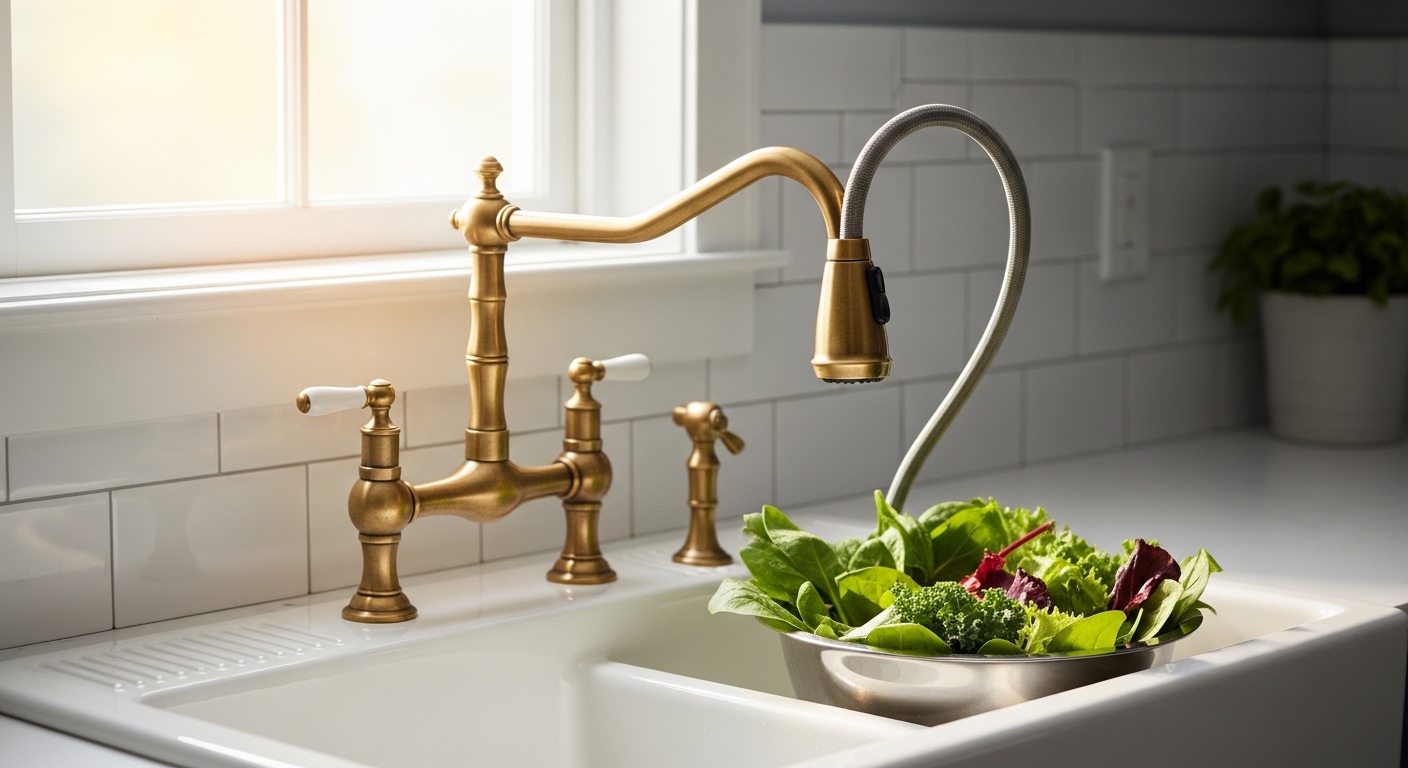
A pull out kitchen tap antique brass model gives you the soft, golden patina of an old farmhouse fixture with the everyday convenience of a retractable spray head — the best of both worlds if your kitchen leans transitional, English country, or warm modern. But “antique brass” is one of the most counterfeited finishes on the market, and a pull-out spout is a mechanically demanding faucet (hose, weight, docking magnet, spray diverter). Get the wrong one and you’ll have a flaking faucet with a stuck hose inside a year. This guide walks you through exactly what to look for, what to pay, and which specs actually matter — written for real shoppers, not spec sheets.
What exactly is a “pull out kitchen tap antique brass” and how is it different from pull-down?
A pull-out kitchen tap is a faucet whose spray head pulls horizontally toward you on a flexible hose, instead of pulling straight down like a pull-down. “Antique brass” refers to the finish — a warm, slightly darkened gold tone meant to look like brass that has aged naturally over decades, often with subtle highlights and lowlights rather than the flat shine of polished brass.
The practical difference matters more than people realize. Pull-out taps usually sit lower (8–12 inches of spout height) with a shorter, more horizontal reach, which makes them perfect for under-cabinet windows, low-profile farmhouse sinks, and smaller kitchens where a tall gooseneck would look bulky. Pull-down taps, by contrast, arch high (14–18 inches) and the spray drops straight into the sink. If you have a window above your sink or a 30-inch single bowl in a cottage-style kitchen, pull-out is almost always the better call.
- Pull-out: shorter spout, spray head pulls toward you horizontally, fits under windows, lighter sprayer feel.
- Pull-down: tall arched spout, spray head pulls straight down, more dramatic look, needs vertical clearance.
- Antique brass finish: warm golden-brown tone with intentional aging; pairs with white, cream, deep green, navy, and natural wood.
Is antique brass actually solid brass — or just a coating?
It depends entirely on the manufacturer, and this is where most buyers get burned. “Antique brass” describes a color, not a material. A $79 Amazon faucet labeled “antique brass” is almost always zinc alloy or stainless with a thin PVD or electroplated coating tinted to look golden-brown. A genuine antique brass faucet has a solid brass body (typically lead-free C46500 or C36000 brass) finished by either physical vapor deposition (PVD) for durability or hand-rubbed/living finish for authenticity.
Here’s the quick test: pick the faucet up. A 1.5–2.5 lb spout body is plastic or thin zinc. A real solid brass pull-out faucet weighs 5–8 lbs total because brass is dense. Also check the listing for the words “lead-free brass” and a certification number like NSF/ANSI 61 or 372 — if those aren’t present, assume the worst. Our team at wowowfaucet-net only sells faucets with a documented brass body and a third-party-tested finish, because we’ve seen too many customers come to us after a cheaper faucet’s finish peeled in the first year.
What’s the difference between PVD antique brass, lacquered, and “living” (unlacquered) brass?
Short answer: PVD is the most durable for daily kitchen use, lacquered brass is the cheapest but the riskiest long-term, and living (unlacquered) brass is the most authentic but requires you to accept patina. Pick based on how much hand you want in the look over time.
| Finish Type | How It’s Made | Lifespan in Kitchen Use | Maintenance | Best For |
|---|---|---|---|---|
| PVD Antique Brass | Vacuum-deposited ion layer fused to brass | 15–25+ years, color-stable | Wipe with damp cloth | Busy families, hard water areas |
| Lacquered Antique Brass | Tinted clear coat over brass | 2–5 years before chipping | Avoid abrasives; reapply lacquer eventually | Powder rooms; low-use kitchens |
| Living / Unlacquered Brass | Raw brass, no top coat | Lifetime; appearance evolves | Embrace patina or polish monthly | Historic homes, design enthusiasts |
| Electroplated (cheap “antique brass”) | Thin chemical tint over zinc | 6 months–2 years | Cannot be restored | Avoid for kitchens |
For a kitchen — where the faucet handles 30+ touches a day and constant water/soap exposure — PVD is what we recommend 90% of the time. If you’re restoring an 1890s Victorian and the patina is the point, unlacquered is beautiful but plan to enjoy the variation. For a deeper dive into how finishes age and which last in real homes, our breakdown of faucet materials and which lasts the longest is worth reading before you click “buy.”
How much should I pay for a quality pull out kitchen tap in antique brass?
Plan to spend $180–$450 for a genuinely good pull-out antique brass faucet, and $450–$900+ for designer or true unlacquered brass models. Anything under $120 is almost guaranteed to be plated zinc with a finish that will not last.
Here’s how the price tiers actually break down in 2026:
- $60–$120 (skip): Zinc-alloy body, plastic internals, thin tinted coating. Looks fine in photos, fails fast in reality.
- $150–$280 (sweet spot for most homes): Solid brass body, ceramic disc cartridge, PVD antique brass finish, nylon-braided hose, magnetic dock. This is where wowowfaucet-net concentrates most of its catalog because it’s where value lives.
- $300–$550 (premium): Heavier brass, Kerox or Neoperl cartridges, ceramic-coated diverter, lifetime warranties, better aerator engineering, sometimes Italian or German manufacturing.
- $600–$1,200+ (designer/luxury): Hand-finished, unlacquered or hand-rubbed living finishes, often unlimited handle/spout configurations, frequently English or Italian heritage brands.
If you’re weighing whether to stretch the budget, we compared the real-world differences in our guide to luxury vs. budget faucets — it explains where the extra money actually goes (and where it doesn’t).
Will antique brass go out of style? Is it a safe choice for 2026 and beyond?
Antique brass is one of the safest “warm metal” choices you can make right now — it’s been in continuous use for over 200 years, has cycled through Victorian, Craftsman, mid-century, and current English-country revivals, and unlike chrome it doesn’t read as a specific decade. Designers consistently include it in long-term color forecasts because it pairs with both cool and warm palettes.
The bigger question for most shoppers is whether antique brass fits their kitchen, not whether it’s trendy. It works best with: white or cream cabinets, deep green or navy cabinets, natural oak or walnut, marble or soapstone counters, and any farmhouse or transitional style. It clashes with: cool grey-blue palettes, anything ultra-minimalist Scandinavian, or kitchens already heavy in chrome or polished nickel hardware. If you want to see how warm vintage tones compare to sleeker modern looks, our piece on modern vs. vintage bathroom faucets applies just as much to kitchens.
What specs actually matter when buying a pull-out antique brass kitchen tap?
Six specs separate a faucet you’ll love in ten years from one you’ll regret in twelve months. Check every one of these before adding to cart:
- Cartridge: Ceramic disc (ideally Kerox, Sedal, or Neoperl branded). Plastic or rubber-washer cartridges fail in 2–4 years.
- Body material: Lead-free solid brass. Look for NSF 372 compliance.
- Hose: Nylon-braided over PEX, not pure PEX or PVC. A good hose lasts the life of the faucet.
- Dock: Magnetic or weighted docking, so the sprayer snaps cleanly back into place. Cheap models droop within months.
- Flow rate: 1.5–1.8 GPM is the modern standard; California requires 1.8 GPM max. WaterSense-labeled models are 1.5 GPM and feel just as strong if the aerator is engineered well.
- Certifications: ASME A112.18.1/CSA B125.1 (mechanical), NSF/ANSI 61 (drinking water safety), NSF/ANSI 372 (lead-free), and UPC listing.
One spec people forget: spray-mode count. You really only need two — stream and spray. Three- and four-mode sprayers add a diverter that can leak or stick within a few years. Simpler is usually more reliable. If you’re already troubleshooting a sprayer that’s misbehaving, our walk-through of how to troubleshoot kitchen faucet spray modes is a useful reference.
How hard is it to install a pull-out antique brass faucet yourself?
It’s a comfortable 60–90 minute DIY project for someone who’s handled basic plumbing before, and a 2-hour first-timer job if you’re patient. The hardest part of a pull-out faucet isn’t the faucet itself — it’s working in the cabinet under the sink with the supply lines, the hose, and the weight.
Here’s the basic flow:
- Turn off both hot and cold shutoff valves under the sink.
- Disconnect supply lines from the old faucet, remove the mounting nut, and lift the old faucet out from above.
- Clean the sink deck.
- Feed the new faucet’s pre-attached hoses and spray hose down through the deck plate hole.
- Tighten the mounting bracket from below.
- Connect supply lines (hand-tight plus a quarter turn with a wrench — don’t overtighten).
- Attach the spray hose to the quick-connect outlet under the spout.
- Clip on the hose weight at the correct height so the spray head retracts smoothly but doesn’t slap the cabinet.
- Turn water back on slowly, check all joints for drips, and run the faucet for 30 seconds to flush debris.
If you’ve never done it before, our complete guide on how to change a faucet in a kitchen sink walks through every step with photos. The two most common mistakes: overtightening the supply nuts (cracks the brass) and installing the hose weight too low (sprayer won’t retract). Both are easy to avoid once you know.
How do I keep antique brass looking right — patina or polished?
For PVD antique brass: wipe with a damp microfiber cloth daily, mild dish soap weekly. Never use abrasive pads, ammonia-based cleaners, or anything containing bleach — those will haze or strip the finish, and most manufacturer warranties become void if you do. PVD doesn’t need polishing because it doesn’t tarnish.
For unlacquered living brass, you have two paths. Path one (recommended): let it patina. The finish will darken and develop subtle variation in 3–12 months, particularly around the handle and spout where hands touch most. This is the look most antique brass shoppers actually want. Path two: polish monthly with a dedicated brass polish like Wright’s or Brasso to maintain a brighter golden tone. Be consistent — patchy polishing looks worse than full patina.
Hard water is the silent killer of any kitchen faucet finish. White scale around the aerator and spray head will dull antique brass within weeks if you don’t address it. A weekly vinegar-soak of the aerator (unscrew it, soak in white vinegar for 20 minutes, rinse, reinstall) keeps the spray pattern crisp and prevents mineral etching. For stubborn cases, our walkthrough on how to unclog a kitchen faucet aerator shows the full process.
What about warranties — what should a real warranty cover?
A reputable pull-out kitchen tap from a real brand should carry a lifetime limited warranty on the faucet body and finish, and at least a 5-year warranty on the cartridge and spray hose. Anything less is a signal the manufacturer doesn’t expect their own product to last. WOWOW Faucet, like other reputable manufacturers, backs its lead-free brass bodies and PVD finishes with a lifetime limited warranty against manufacturing defects and finish failure under normal residential use, plus dedicated replacement-parts support — which is the thing that actually matters when a hose or cartridge needs swapping in year seven.
Read the fine print, though. “Lifetime” usually means original purchaser, original installation, and excludes commercial use, abrasive cleaner damage, hard-water scale buildup, and finish damage from acidic foods (lemon juice especially). Keep your receipt and the model number — both are typically required for any claim.
Author note & brand credibility
This guide was written by the wowowfaucet-net content team in collaboration with our product engineers, who source, test, and certify every faucet we carry. WOWOW has been designing kitchen and bath fixtures for over a decade, with products that meet ASME A112.18.1, NSF/ANSI 61, NSF/ANSI 372 (lead-free), and cUPC standards. Every faucet we ship is bench-tested for 500,000 open/close cycles on the cartridge and 100,000 cycles on the pull-out hose dock — well beyond typical residential use over 20+ years. We don’t sell what we wouldn’t install in our own kitchens.
FAQ
Does a pull out kitchen tap in antique brass match stainless steel appliances?
Yes, surprisingly well. Antique brass adds warmth that breaks up the cool grey of stainless, and the contrast is a deliberate design choice in transitional kitchens. The trick is to repeat the brass tone in 1–2 other places (cabinet pulls, a pendant light, a soap dispenser) so the faucet doesn’t read as a lonely accent.
Will the antique brass finish tarnish over time?
PVD antique brass will not tarnish — it’s color-stable for the life of the faucet. Unlacquered living brass will patina, which is usually the goal. If your “antique brass” faucet starts showing greenish corrosion or black spots within the first year, it’s almost certainly a plated zinc fake, not real brass.
Can I install a pull-out antique brass faucet in a 1-hole or 3-hole sink?
Most modern pull-out faucets are designed for 1-hole installation but come with an optional deck plate (escutcheon) that covers 3-hole configurations. Check the product listing for “1 or 3 hole installation” — almost every quality model includes this flexibility. The deck plate should match the faucet finish exactly.
Is 1.5 GPM enough flow for a kitchen faucet?
Yes, if the aerator and pressure compensator are well-engineered. A good 1.5 GPM kitchen faucet feels indistinguishable from an older 2.2 GPM model for filling pots and rinsing dishes, because the aerator concentrates the stream. Look for WaterSense certification as a quality indicator.
How do I tell a real solid brass faucet from a plated zinc fake before I buy?
Three signals: weight (real brass pull-out faucets weigh 5–8 lbs total), listed material (“lead-free brass” or specific alloy like C46500), and certifications (NSF/ANSI 61 and 372). If the product page is vague about materials and the price is under $100, assume zinc alloy.
How long should a quality pull out kitchen tap last?
A solid brass pull-out kitchen tap with a ceramic disc cartridge and PVD antique brass finish should give you 20–25+ years of reliable service, with the cartridge possibly needing one replacement somewhere around year 12–15. The hose is the most-replaced part and typically lasts 8–12 years. Plated zinc faucets, by contrast, average 18–36 months before the finish or internals fail.