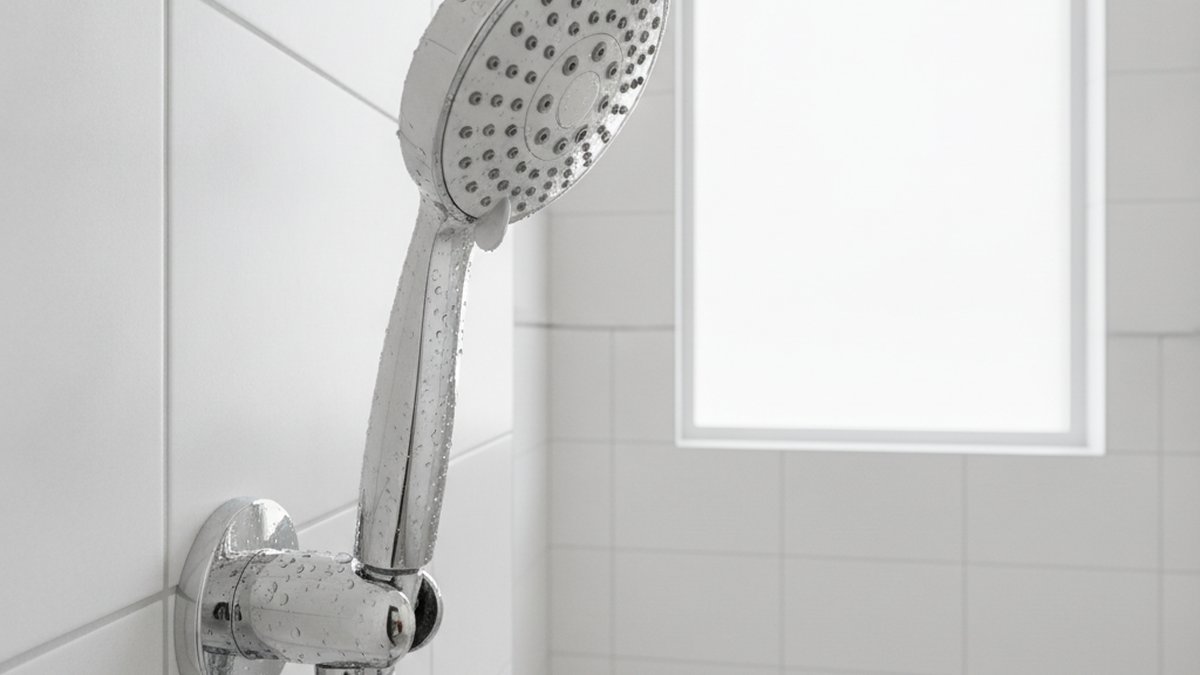
A handheld shower head in chrome is a shower head mounted on a flexible hose (usually 59–72 inches long) with a bright, mirror-like polished chrome finish, letting you lift it off a wall bracket to aim the spray exactly where you want it. It’s the single most practical shower fixture for real life — you stop contorting under a fixed head and start directing the water instead. And because chrome is the industry’s default neutral finish, it blends with brushed nickel, stainless, and even most brushed-gold trim without clashing. Below, we answer the actual questions people ask before buying one: whether chrome is the right finish, how to pick the spray type, how it installs, and what separates a good one from a cheap one that cracks in a year.
Is chrome actually the best finish for a handheld shower head?
For most bathrooms, yes — chrome is the best all-around finish for a handheld shower head because it’s the most durable-against-water, easiest to clean, cheapest, and most universally matching option on the market. Here’s the honest breakdown.
Chrome is a thin layer of actual chromium electroplated over brass or a brass/zinc alloy base. That chromium layer is extremely hard and chemically stable, which is why chrome resists rust, tarnish, and the pitting that cheaper finishes develop over years of hot, mineral-heavy water. It also has a cool, blue-ish mirror tone that reflects its surroundings, so light water spotting is far less visible than it is on matte black or brushed gold — a spotted matte-black head looks dirty from across the room, while chrome mostly just looks wet.
The trade-offs are real but minor. Polished chrome shows fingerprints and dried mineral streaks if you have hard water and never wipe it. It’s also a “builder standard” look — if your whole bathroom is matte black or brushed brass and you want a designer statement, chrome will read as plain. But for the overwhelming majority of homes, chrome is the safe, timeless, budget-friendly choice that will still look right in ten years.
Chrome vs. brushed nickel vs. matte black vs. brushed gold
Short answer: pick chrome for the best durability and price, brushed nickel to hide water spots in hard-water homes, and matte black or brushed gold only when you’re matching a specific design and willing to wipe them down more often.
| Finish | Look | Hides water spots? | Cleaning effort | Typical price (handheld) | Best for |
|---|---|---|---|---|---|
| Polished chrome | Bright, reflective, cool-toned | Fairly well | Low | $25–$80 | Almost any bathroom; best value |
| Brushed nickel | Warm, satin, soft sheen | Best | Lowest | $30–$95 | Hard-water homes, warm palettes |
| Matte black | Flat, modern, dramatic | Poorly | High | $40–$120 | Modern/industrial design builds |
| Brushed gold / champagne bronze | Warm, luxe, trendy | Moderate | Moderate–high | $50–$150 | Statement baths, warm-metal schemes |
If you’re mixing metals in the room, chrome is the easiest to pair because its neutral tone doesn’t fight anything. If your bathroom already leans warm, you might instead look at a brushed gold lav faucet and coordinate the shower to match — but know you’re signing up for a bit more upkeep than chrome.
What spray type and flow rate should you look for?
Look for a handheld with at least 3–5 spray settings, a flow rate of 1.75–2.5 GPM, and a solid-feeling diverter or trigger that clicks cleanly between modes. Spray quality matters far more than spray count — a head with 3 good modes beats one advertising “9 functions” that are all mushy.
Here are the spray modes that actually get used, versus the ones that are marketing filler:
- Full/rain spray — your everyday wide, even coverage. This is the mode you’ll use 90% of the time, so test that it feels full and not scattered.
- Massage/pulse — concentrated pulsing jets for sore shoulders and lower back. Genuinely useful.
- Mist/aerated — softer, air-infused spray that’s gentle on kids and good for rinsing without blasting.
- Jet/concentrated stream — a tight, powerful stream perfect for rinsing the tub, cleaning the walls, or washing a dog.
- Pause/trickle — reduces flow to a trickle so you can lather up without turning off the valve. Underrated for saving water.
On flow rate: U.S. federal law caps shower heads at 2.5 GPM, and many states (California, Colorado, Washington, New York) cap them lower at 1.8 GPM. A 1.75–1.8 GPM head saves water and still feels strong if it’s engineered with good pressure-compensating nozzles. If you have chronically weak pressure, don’t just chase a high GPM number — the problem is often upstream. We cover that in detail in our guide on why faucet and shower water pressure is too low and how to fix it.
How do you install a handheld shower head in chrome yourself?
You can install a handheld shower head in chrome in about 10 minutes with no tools beyond your hands and maybe a strip of plumber’s tape — it threads onto the same standard ½-inch NPT shower arm your old fixed head came off of. No plumber, no shutting off the main water line.
The standard kit includes the shower head, a flexible hose, a wall-mount bracket or an adjustable holder, and rubber washers. Most handheld sets simply replace the fixed head. If you want it to come off a tub spout instead of an existing shower arm, you’ll need the right adapter — see our breakdown of the bathtub faucet adapter you need to connect a hose or handheld shower.
- Unscrew the old head. Turn it counterclockwise by hand. If it’s stuck, grip with a cloth-wrapped wrench so you don’t scratch the chrome arm.
- Clean the threads. Peel off old plumber’s tape and wipe the shower arm threads clean.
- Wrap the threads. Apply 3–4 wraps of PTFE plumber’s tape clockwise around the shower arm threads. This prevents leaks at the connection.
- Attach the bracket/holder. Thread the wall mount or holder onto the shower arm hand-tight, then snug a quarter-turn with a cloth-wrapped wrench.
- Connect the hose. Screw one end of the hose to the holder and the other to the handheld head. Make sure the rubber washer (not a metal one) sits inside each connector — the washer, not over-tightening, is what seals it.
- Test. Run the water, check for drips at every joint, and cycle through the spray modes. A tiny drip usually means a missing washer or crooked threads, not a bad fixture.
Measuring before you buy matters, especially hose length and how high the bracket sits for the tallest person in the house. Our guide to handheld shower head dimensions walks through exactly what size you need for your shower.
Is a handheld shower head good for a family, elderly, or pets?
Yes — the handheld design is the single best shower upgrade for families, aging-in-place safety, and pet owners, because being able to detach and aim the spray solves problems a fixed head can’t. This is where a handheld earns its money.
For kids, you can rinse shampoo out of hair without it running into their eyes, and wash a toddler sitting in the tub without soaking the whole bathroom. For older adults or anyone with limited mobility, a handheld paired with a slide bar or a shower seat means you can bathe seated and bring the water to you — a core accessibility recommendation. For pet owners, the concentrated jet mode turns the tub into a dog-wash station. And for everyone, cleaning the shower itself goes from a chore to a 60-second rinse-down.
If accessibility is your main driver, look for a longer hose (72 inches), an ADA-friendly bracket with an easy-grip handle, and a head that’s lightweight enough to hold comfortably. Many handheld sets are sold as part of a larger kit — if you’re redoing the whole valve and trim at once, read what actually comes in a shower faucet set so you don’t buy duplicate parts.
What separates a good chrome handheld from a cheap one that fails?
The difference is in three parts you can’t see in a product photo: the base metal under the chrome, the hose construction, and the washers/seals. A good one lasts a decade; a cheap one cracks, leaks, or peels within a year.
- Base metal: Better heads plate chrome over brass or a dense zinc alloy. The cheapest plate thin chrome over hollow ABS plastic — it looks identical in the box but feels light and can crack where the hose connects. A little weight in the hand is a good sign.
- Hose: Look for a stainless-steel braided or interlocked hose, ideally with a brass core on the fittings. All-plastic hoses kink, and plastic fittings strip their threads. Double-interlock stainless hoses resist kinking and last the longest.
- Nozzles: Silicone/rubber “self-cleaning” nozzles let you rub off mineral buildup with your thumb. Rigid metal or plastic nozzles clog with limescale and never spray evenly again.
- Seals: Quality rubber washers and a smooth ceramic or well-machined diverter are what keep it leak-free. Grit or burrs in the diverter cause the dribbles people blame on “bad water pressure.”
Hard water is the biggest long-term enemy. Minerals clog nozzles and leave spotting. The fix is periodic descaling — the same vinegar-soak method we describe for a clogged or spitting kitchen faucet head works on a shower head: unscrew it, soak it in warm white vinegar for 30–60 minutes, scrub the nozzles, and rinse.
How much should you spend, and when is a full shower system better?
Spend $30–$70 for a quality chrome handheld that will genuinely last; below $20 you’re usually buying plastic that fails, and above $100 you’re paying for brand or designer finishes, not better function. A handheld swap is the best-value shower upgrade there is.
But if your valve is old, your trim is dated, or you want both a fixed rain head and a handheld on a diverter, it can make more sense to upgrade the whole unit at once rather than piecemeal. Understand the difference before you buy — a single head versus an integrated valve-and-trim package — in our explainer on what a shower faucet unit is and which one to buy. Canadian buyers weighing a complete setup should also see our regional guide to the best shower system in Canada, since flow-rate rules and availability differ north of the border.
Author note & why you can trust this guide
This guide was written by the WOWOW Faucet product team, drawing on years of designing, bench-testing, and field-servicing shower fixtures. We pressure-test every handheld model across the full 1.75–2.5 GPM range, cycle the diverters thousands of times, and salt-spray-test chrome plating for corrosion resistance before it ships. WOWOW manufactures faucets and shower fixtures that meet cUPC / NSF/ANSI 61 lead-safety and EPA WaterSense standards where applicable, and our shower heads are backed by a limited lifetime warranty against defects in finish and function. When we recommend a spec here, it’s because we’ve watched what holds up in real bathrooms and what comes back as a warranty claim.
FAQ
Does a handheld shower head in chrome fit my existing shower arm?
Almost certainly yes. Shower arms in North America use a universal ½-inch NPT thread, and virtually every handheld kit is built to match it. You simply unscrew the old head and screw on the new bracket and hose — no adapter needed unless you’re connecting to a tub spout instead of a shower arm.
Will a chrome handheld shower head rust or peel?
Good-quality chrome over a brass or zinc base resists rust and peeling for many years because chromium is chemically stable and extremely hard. Cheap chrome plated over thin plastic can eventually flake, especially at stress points like the hose connector. Buy one with a metal base and a real warranty, and rinsing plus an occasional wipe-down is all the maintenance it needs.
How do I keep hard water from clogging and spotting the chrome?
Wipe the head dry after showers to prevent spotting, and descale it every few months by soaking it in warm white vinegar for 30–60 minutes, then scrubbing the nozzles. Heads with flexible silicone nozzles make this easiest — you can rub mineral buildup off with your thumb. Avoid abrasive pads or acidic bathroom cleaners that can dull the chrome.
What hose length should I get?
For a standard shower, a 59–60 inch hose is plenty. For a tall user, a walk-in shower, accessibility needs, or bathing a seated person, go with a 72-inch hose so you have reach to spare. Stainless-steel braided hoses in that length resist kinking far better than plastic ones.
Can I use a handheld shower head with a tub spout instead of a shower arm?
Yes, with the right adapter. If your tub has no shower arm, you can add a diverter adapter to the tub spout that lets you connect the handheld hose. Check the spout threads and spout type first, since not all tub spouts accept an adapter — our bathtub faucet adapter guide covers which one you need and how it connects.
Does a handheld shower head reduce water pressure?
Not if it’s well made. A quality handheld with pressure-compensating nozzles can feel just as strong at 1.8 GPM as an old fixed head at 2.5 GPM. If your spray feels weak, the cause is usually clogged nozzles, a kinked hose, or low household pressure rather than the handheld design itself — clean the head and check the hose before assuming the fixture is the problem.