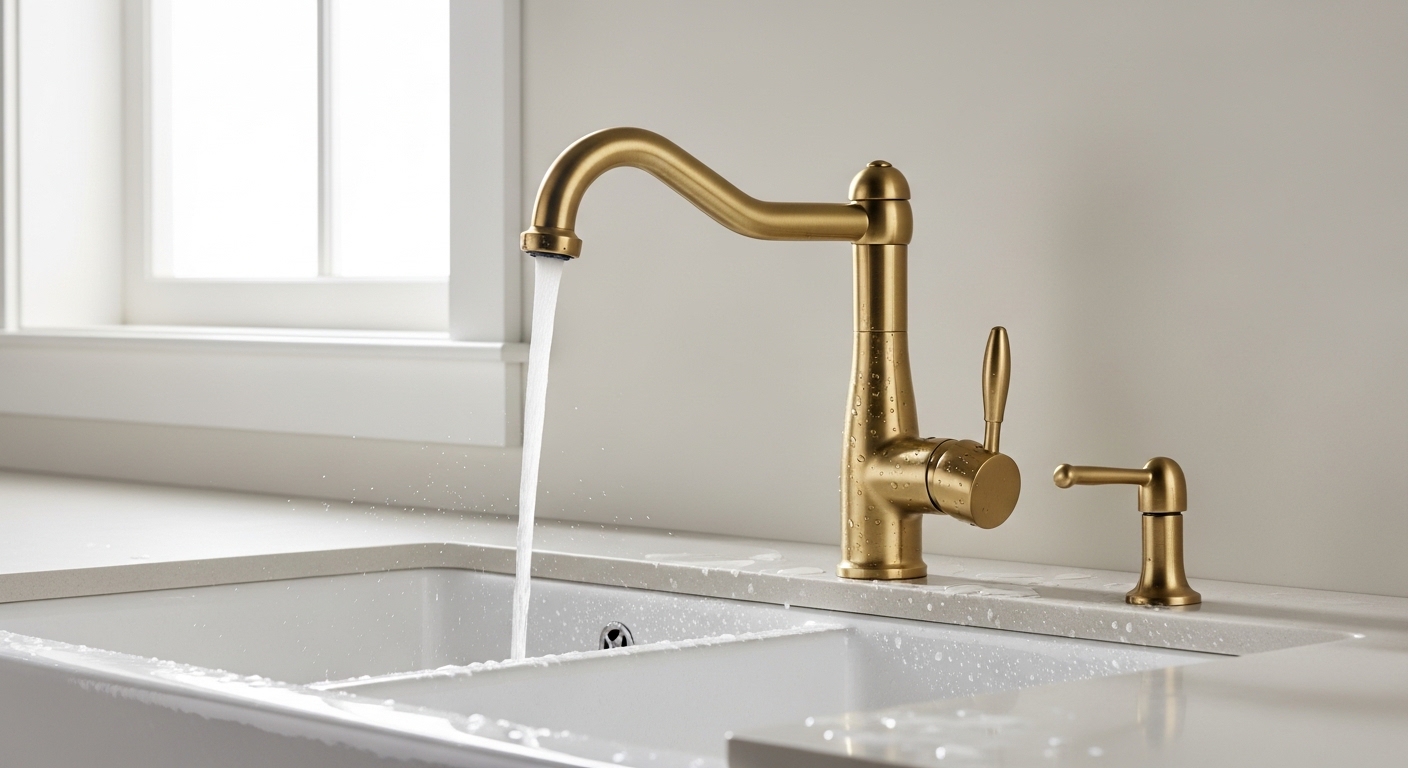
If you’re shopping for the best kitchen faucets 2026 can offer, here’s the honest truth: the “best” one depends on your sink depth, your water hardness, and whether you cook enough to justify a touchless model. But the fundamentals that separate a faucet you’ll love for 15 years from one you’ll be cursing in 18 months come down to a short list of specs — cartridge type, body material, spray-head docking, and finish durability. Get those four right and you’ve bought well, whether you spend $130 or $400.
This guide walks through exactly what matters, compares the main faucet styles head-to-head, gives real price ranges, and answers the questions people actually ask before they buy. No fluff — just what a plumber would tell you if you cornered them at the hardware store.
What features actually make a kitchen faucet “the best” in 2026?
The best kitchen faucets in 2026 all share four things: a ceramic disc cartridge (not rubber washers), a solid brass or 304 stainless steel body, a magnetic dock that snaps the spray head back into place, and a PVD or spot-resist finish that shrugs off fingerprints. Everything else — voice control, LED temperature rings, filtered water lines — is a nice-to-have, not a deal-breaker.
Here’s why those four matter in plain terms:
- Ceramic disc cartridge: This is the valve that turns water on and off. Ceramic discs are what stop drips. A quality cartridge is rated for 500,000+ open/close cycles — roughly 20+ years of normal use. Cheap faucets use lower-grade cartridges that start dripping in a year or two.
- Solid brass or 304 stainless body: Zinc-alloy or plastic bodies corrode and crack, especially with hard water. Brass and 304 stainless resist corrosion and hold threads tightly. If you want the longest-lasting option, our breakdown of which faucet materials last the longest covers this in detail.
- Magnetic docking: Older pull-down faucets used a weighted counterbalance that sagged over time, so the spray head would droop instead of snapping home. Magnetic docking fixed that. It’s now standard on any faucet worth buying.
- Durable finish: PVD (physical vapor deposition) finishes are bonded at the molecular level and won’t flake. “Spot resist” or “spot-free” coatings hide water spots and fingerprints — a real quality-of-life upgrade on brushed nickel and matte black.
Pull-down vs. pull-out vs. commercial-style: which type should I actually buy?
For most home kitchens, a pull-down faucet is the best choice — it gives you a tall, elegant spout and a spray head that pulls straight down into the sink. Choose a pull-out instead if you have a low window behind the sink, and choose a commercial-style spring-neck faucet only if you cook heavily and fill big pots. Here’s how they compare.
| Faucet Type | Best For | Typical Height | Price Range (2026) | Watch Out For |
|---|---|---|---|---|
| Pull-Down | Most kitchens, deep sinks | 15″–18″ | $120–$300 | Too tall for a low window |
| Pull-Out | Low windows, small sinks | 7″–10″ | $90–$220 | Shorter reach into big sinks |
| Commercial / Spring-Neck | Heavy cooks, pot filling | 18″–28″ | $180–$500 | Can splash in a shallow sink |
| Touchless (any style) | Busy families, hygiene | Varies | $200–$450 | Needs batteries or an outlet |
A quick reality check on height: measure from the sink deck to the bottom of any window or cabinet above. A 17″ pull-down spout with the handle up needs roughly 20″ of clearance. If you’ve only got a foot of space under a windowsill, a pull-out or a low-arc faucet is the smart move.
How much should I spend on a good kitchen faucet in 2026?
Plan on $120–$250 for an excellent everyday kitchen faucet, and $250–$450 if you want touchless operation or a premium PVD finish like brushed gold or matte black. Below about $80 you’re gambling on cartridge and body quality; above $500 you’re mostly paying for a designer brand name, not better function.
The truth is that the price-to-quality curve flattens fast. A well-made $180 faucet and a $600 faucet often use the same grade of ceramic cartridge and solid-brass body — the difference is finish exclusivity, brand prestige, and sometimes smart features. If you want the full argument on where the money actually goes, we broke it down in luxury vs. budget faucets compared. Spend where it counts: cartridge, body material, and warranty.
One overlooked cost factor is your home’s water pressure. A faucet rated for 60 PSI behaves very differently on a 35 PSI supply — the spray gets weak and the “powerful” spray mode underwhelms. It’s worth learning how to check faucet pressure before buying so you don’t blame the faucet for a plumbing issue.
Is a touchless kitchen faucet worth it, or is it a gimmick?
A touchless kitchen faucet is genuinely worth it if you cook with raw meat, have kids, or hate cleaning greasy handle smudges — the motion sensor keeps the faucet clean and saves water. It’s a gimmick only if you buy a cheap one with a laggy or oversensitive sensor. Good touchless faucets in 2026 respond in under a second and let you still use the manual handle for temperature.
What to look for in a touchless model:
- Dual sensors — one at the base and one at the top of the spout — so you can wave a hand or place a pot underneath without false triggers.
- A manual override handle so you set temperature the normal way and the sensor only controls on/off.
- Battery life of 6–12 months on AA batteries, or an AC adapter option if you have an outlet under the sink.
- An auto-shutoff timer (usually 3 minutes) that prevents a runaway faucet if the sensor gets bumped.
The one honest downside: touchless faucets have electronics that can eventually fail, whereas a manual faucet is dead-simple. If you keep faucets for 20 years, factor that in. For a busy family kitchen, most people find the convenience well worth it.
What’s the best kitchen faucet finish for hard water and fingerprints?
For hard water, brushed/satin finishes like brushed nickel, stainless, and brushed gold hide mineral spots far better than polished chrome. For fingerprints, choose any finish labeled “spot resist” or “spot-free,” or go with matte black, which shows water spots less than glossy surfaces but can show hard-water chalk if you don’t wipe it. Polished chrome looks stunning but shows every drop and smudge.
| Finish | Hides Water Spots | Hides Fingerprints | Style Vibe |
|---|---|---|---|
| Brushed / Satin Nickel | Excellent | Excellent | Warm, timeless |
| Brushed Gold / Champagne Bronze | Excellent | Very good | Modern luxury |
| Matte Black | Good | Very good | Bold, contemporary |
| Stainless Steel | Very good | Good | Neutral, practical |
| Polished Chrome | Poor | Poor | Bright, classic |
If your area has hard water, a brushed finish plus a spray head with easy-to-clean silicone nozzles will save you a lot of scrubbing. Rubber or silicone nozzle tips let you wipe away mineral buildup with your thumb instead of soaking the aerator.
Can I install a new kitchen faucet myself, or do I need a plumber?
Most people can install a kitchen faucet themselves in 45–90 minutes with a basin wrench, an adjustable wrench, and plumber’s tape — no soldering required on modern faucets with braided supply lines. You only need a plumber if your shutoff valves are seized, your supply lines are corroded copper that needs replacing, or you’re moving the faucet to a new hole.
The basic process looks like this:
- Turn off the hot and cold shutoff valves under the sink and open the old faucet to release pressure.
- Disconnect the supply lines and use a basin wrench to loosen the old mounting nuts.
- Remove the old faucet, clean the deck, and drop in the new one through the mounting hole.
- Tighten the mounting hardware from below, then connect the braided supply lines to the shutoff valves with plumber’s tape on the threads.
- Turn the water back on slowly and check every connection for drips.
For a full walkthrough with photos, see our step-by-step guide on how to change a faucet in a kitchen sink. And if your new faucet’s spray modes ever act up after install, our guide on how to troubleshoot kitchen faucet spray modes covers the usual culprits — usually a clogged aerator or a kinked hose, not a defective faucet.
What kitchen faucet specs should I check before I click “buy”?
Before buying, confirm five specs: the number of mounting holes your sink has, the spout reach and height, the flow rate, the cartridge type, and the warranty length. Getting the hole count wrong is the single most common ordering mistake — a 3-hole sink needs either a 3-hole faucet or a deck plate to cover the extra holes.
- Mounting holes: Count them. 1-hole faucets often include an optional deck plate to cover a 3-hole sink. Look for a base plate rated for 1 or 3 holes.
- Spout reach & height: Reach should land the water near the center of the sink or the drain, not the back wall.
- Flow rate: Most modern faucets are 1.5–1.8 GPM. Lower saves water; higher fills pots faster. WaterSense-labeled models cap at 1.8 GPM or less.
- Cartridge type: Ceramic disc, ideally from a brand with cheap, available replacement cartridges.
- Warranty: A lifetime limited warranty on the finish and function is the industry standard for quality faucets. Anything shorter is a red flag.
Author’s note & why you can trust this guide
This guide was written by the wowowfaucet-net product team — the same people who design, pressure-test, and warranty the faucets we sell at www.wowowfaucet.net. Every faucet we build is cycle-tested to industry cartridge-durability standards (500,000+ open/close cycles), pressure-tested before it ships, and backed by a lifetime limited warranty on finish and function. We also make sure our models meet eco-certification standards like WaterSense and lead-free NSF/ANSI 61 compliance for drinking-water safety. We’ve fielded thousands of real customer questions about hard water, low pressure, and installation headaches — the advice above reflects those patterns, not marketing copy.
Bottom line for 2026: buy a single-handle pull-down with a solid-brass or 304 stainless body, a ceramic disc cartridge, magnetic docking, and a brushed finish if you have hard water. Spend $150–$250 and you’ll have a faucet that looks great and works flawlessly for well over a decade.
FAQ
What is the most reliable type of kitchen faucet?
A single-handle pull-down faucet with a ceramic disc cartridge and a solid-brass body is the most reliable type. It has fewer failure points than double-handle or heavily electronic models, and the ceramic cartridge is what prevents drips for 20+ years. Fewer moving parts and quality materials beat fancy features for long-term reliability.
Are expensive kitchen faucets really better than budget ones?
Not always. Above roughly $200, you’re often paying for brand prestige and exclusive finishes rather than better internal function. A $180 faucet with a ceramic cartridge, brass body, and lifetime warranty can outlast a $500 designer faucet. Focus your budget on cartridge quality, body material, and warranty rather than the price tag alone.
How long should a good kitchen faucet last?
A quality kitchen faucet should last 15–20 years, with the ceramic cartridge rated for 500,000+ cycles. Finishes with PVD coating can look new for a decade or more. The most common failures are worn cartridges (cheap to replace) and cracked zinc-alloy bodies (why you should buy brass or stainless).
What flow rate should a kitchen faucet have in 2026?
Aim for 1.5–1.8 GPM (gallons per minute). WaterSense-labeled faucets cap at 1.8 GPM while still feeling powerful thanks to aerator design. Go toward 1.8 GPM if you fill large pots often; 1.5 GPM saves more water for everyday use. Anything much higher just wastes water without a real benefit.
Do I need a plumber to replace my kitchen faucet?
Usually no. If your under-sink shutoff valves work and your supply lines are in good shape, most people can swap a faucet in under 90 minutes with basic tools. Call a plumber only if the shutoff valves are seized, the supply lines are corroded, or you need to add or move mounting holes in the sink or countertop.
Which kitchen faucet finish is easiest to keep clean?
Brushed or satin finishes — brushed nickel, stainless, and brushed gold — are easiest to keep clean because they hide both water spots and fingerprints. Look for “spot resist” or “spot-free” coatings for the best results. Polished chrome is the hardest to keep spotless because it shows every drop and smudge.