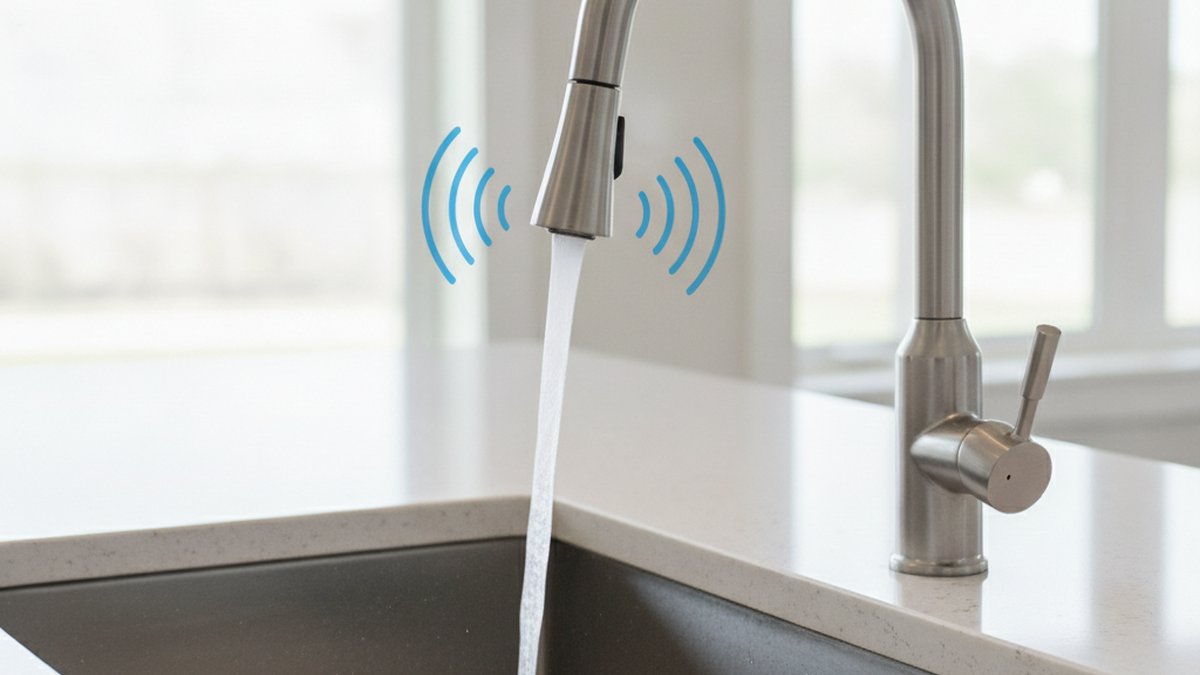
If you’re standing at your sink asking “why is my faucet so loud,” the good news is that the sound itself is a clue. A screech, a hum, a whistle, a knock, a rattle, and a sputter each point to a different cause — and each has a different, usually cheap fix. A noisy faucet is rarely a sign that the whole fixture is dying. Far more often it’s a $5 washer, a mineral-clogged aerator, or a pressure setting that crept too high. Below we’ll walk through exactly what each noise means, how to track it down, and how to silence it for good.
What does the specific noise tell me about the cause?
The type of sound is the single fastest way to diagnose the problem. A high-pitched whistle or squeal usually means water is forcing its way past a worn part or a partial blockage. A deep knock or bang points to water hammer or trapped air. A low hum or vibration usually means excessive pressure or a loose component. Match your noise to the table below before you touch a wrench.
| Noise you hear | Most likely cause | Typical fix | Rough cost |
|---|---|---|---|
| High-pitched whistle or squeal (only when open) | Worn cartridge, stem washer, or clogged aerator | Replace cartridge/washer or clean aerator | $0–$25 |
| Loud bang or knock when you shut it off | Water hammer — pressure surge with nowhere to go | Add/reset a water-hammer arrestor; lower pressure | $15–$40 |
| Sputtering, spitting, hissing air | Trapped air in supply lines | Bleed the lines by running faucets | $0 |
| Steady hum or vibration while running | Water pressure too high (over 80 psi) | Adjust pressure-reducing valve | $0–$350 |
| Rattle or chatter behind the wall | Loose pipe not secured to a stud | Add pipe strap/cushion clamp | $5–$20 |
Why does my faucet squeal or whistle when I turn it on?
A squealing faucet is almost always a worn washer or cartridge, and it’s the most common noise complaint we hear. Inside every faucet is a moving part — a rubber washer on older compression faucets, or a cartridge on modern single-handle and pull-down models — that controls the flow. When the rubber hardens, cracks, or the cartridge scores from years of hard water, water squeezes past the imperfect seal at high speed and vibrates the part. That vibration is the squeal.
To confirm it, notice when the noise happens. If the whistle only shows up at a certain handle position (say, halfway open) and disappears when the faucet is fully open, that’s a classic worn-washer or cartridge signature. Here’s how to chase it down:
- Shut off the supply valves under the sink and open the faucet to drain the line.
- Pop the handle cap, remove the handle screw, and lift the handle off.
- Pull the cartridge or unscrew the stem to reach the washer.
- Inspect the rubber and the seat — if the washer is flattened, cracked, or grooved, swap it for an exact match.
- For a cartridge, take the old one to the store or order the matching model number so you get the right fit.
Cartridge swaps are genuinely DIY-friendly. If you’ve got a single-handle kitchen unit, our step-by-step on how to install a kitchen faucet cartridge yourself walks through the exact sequence, and for centerset bathroom taps the Moen centerset cartridge guide shows you how to identify the right part. Brand-specific valves like Rubinet have their own quirks, covered in our Rubinet cartridge replacement walkthrough.
Why does my faucet sputter, spit, and hiss with air?
A sputtering faucet that spits water and air in bursts almost always means trapped air in your supply lines — and it usually fixes itself for free. Air gets into the pipes after the water was shut off for repairs, after municipal work on the street, or when a well pump loses prime. The trapped pockets get pushed through the aerator and come out as a hissing, spitting stream.
The fix is to bleed the air out. Start with the faucet lowest in the house and closest to the water meter, then work upward and outward. Turn each faucet on full — both hot and cold — and let it run for a minute or two until the stream goes smooth and quiet. Flush toilets too. The moving water pushes the air pockets ahead of it and out the highest fixtures. If the sputtering only affects one faucet, the trapped air may be sitting in a clogged aerator instead — which brings us to the next culprit.
Can a dirty aerator really make my faucet loud?
Yes — a clogged aerator is one of the most overlooked causes of a loud faucet, and it’s a five-minute fix. The aerator is the little screened tip that screws onto the end of your spout. It mixes air into the water for a soft, splash-free stream. When hard-water minerals, sediment, or tiny rust flakes build up on that screen, water is forced through a shrinking opening at higher velocity, which creates a whistle, hiss, or high-pitched hum.
Unscrew the aerator by hand (or with tape-wrapped pliers so you don’t scratch the finish), and look at it. If you see white crusty scale or dark grit, that’s your noise. Soak the parts in white vinegar for 20 to 30 minutes to dissolve the mineral scale, scrub the screen with an old toothbrush, rinse, and reassemble. If it’s badly corroded, a new aerator costs a couple of dollars. This same mineral buildup clogs pull-down spray heads too — our guide on how to clean a kitchen faucet head when it’s clogged or spitting covers the spray-face version of this exact problem. If your home has hard water, expect to do this once or twice a year.
| Cleaning method | Best for | Time | Effectiveness on scale |
|---|---|---|---|
| White vinegar soak | Light to moderate mineral scale | 20–30 min | High |
| CLR / commercial descaler | Heavy, stubborn buildup | 5–10 min | Very high (follow label) |
| Toothbrush + rinse only | Loose grit and sediment | 5 min | Low–medium |
| Full aerator replacement | Corroded or cross-threaded parts | 5 min | Permanent |
Why does my faucet bang or knock when I shut it off?
A loud bang the instant you close the faucet is water hammer — a pressure shockwave caused by fast-moving water slamming to a sudden stop. When you snap a quarter-turn or lever faucet shut, all that momentum has nowhere to go, so it hammers against the pipe and the valve, producing a knock that can rattle the whole wall. It’s not just annoying; over time water hammer stresses joints and can cause leaks.
There are three good fixes, from easiest to most involved:
- Reset your air chambers. Many homes have vertical capped pipe stubs near fixtures that act as air cushions. When they fill with water they stop working. Shut off the main, open the highest and lowest faucets to drain the system fully, then turn the water back on — this re-charges the chambers with air.
- Install a water-hammer arrestor. These screw onto the supply lines under the sink or at the washer hookups and contain a sealed air piston that absorbs the shock. They’re inexpensive and don’t waterlog like old-style air chambers.
- Lower your water pressure. High pressure makes hammer worse — see the next section.
Washing machines and dishwashers with fast solenoid valves are frequent hammer culprits too, so if the bang coincides with an appliance cycle, start the arrestor there.
Is my water pressure too high, and is that causing the hum?
A constant hum or vibration whenever the faucet runs usually means your water pressure is too high — above the 80 psi that most plumbing codes cap. Excess pressure forces water through valves and cartridges hard enough to make the whole assembly resonate, and it dramatically worsens both squealing and water hammer. It also shortens the life of every washer, cartridge, and supply hose in the house.
Buy a $10 pressure gauge that screws onto a hose bib or laundry faucet and check the reading. Anything from 45 to 70 psi is the healthy sweet spot. If you’re reading 85, 90, or higher, you likely need to adjust or install a pressure-reducing valve (PRV) where the main line enters your home. Turn the adjustment screw clockwise to lower pressure, then re-check the gauge. If you don’t have a PRV at all and your municipal pressure runs high, adding one is worth the call to a plumber. Low pressure causes its own noise problems too — if your issue is the opposite, our guide on why faucet water pressure is too low and how to fix it tackles that side of the coin.
Why is only my hot water faucet loud?
If the noise shows up only on the hot side, the source is usually your water heater or the hot-water lines, not the faucet itself. A screeching or singing sound that’s worse with hot water often comes from sediment built up at the bottom of the water heater tank, or from a failing heat trap or check valve on the heater’s nipples. Thermal expansion also makes hot pipes tick and knock as they heat and rub against framing or straps.
Try flushing your water heater to clear sediment (drain a few gallons from the tank’s bottom valve until it runs clear). If the hot pipes tick and rattle as they warm up, the fix is usually to cushion where they pass through wall plates and add insulation — the same loose-pipe issue below, just triggered by heat expansion instead of pressure.
What if the noise is coming from inside the wall, not the faucet?
A rattle or chatter that seems to come from behind the wall rather than the spout means a supply pipe isn’t properly secured to the framing. When water rushes through an unstrapped or loosely strapped pipe, the flow makes it vibrate against studs, joists, or drywall — turning your wall cavity into a drum. This is common in older homes and in any run where a pipe passes through an oversized hole.
The fix is to secure the pipe. If you have access (a basement, crawlspace, or the cabinet behind the fixture), add a cushioned pipe clamp or a padded strap where the pipe is loose, and slip foam pipe insulation anywhere a pipe touches framing so it can’t buzz against the wood. Don’t clamp copper pipe rigidly against metal without a cushion — you want to dampen vibration, not create a new contact point. While you’re under the sink, it’s also worth checking whether a too-short or kinked supply line is contributing; our guide on fixing a faucet supply line that’s too short covers replacing those safely.
How do I diagnose a loud faucet step by step?
Work from cheapest and easiest to most involved — you’ll usually solve it before you get very far. Here’s the order we recommend:
- Clean the aerator. Free and five minutes. Solves a surprising share of whistles and hums.
- Bleed the lines. Run every faucet hot and cold for two minutes to clear trapped air.
- Check water pressure with a gauge. Bring it to 45–70 psi if it’s high.
- Inspect and replace the cartridge or washer if the noise is position-dependent.
- Add a water-hammer arrestor if you get a bang on shutoff.
- Secure loose pipes if the sound lives inside the wall.
If you’ve done all six and the noise persists, or if you suspect the water heater or main pressure valve, that’s the point to bring in a licensed plumber — those jobs touch the whole system rather than one fixture.
When should a loud faucet make me worry?
Most faucet noise is harmless and cosmetic, but a few signs mean act sooner. Persistent water hammer can loosen joints and cause hidden leaks, so don’t ignore a hard bang for months. A sudden new whistle combined with dropping flow can signal a failing pressure regulator or a supply-line restriction. And if you ever hear noise paired with discolored water, that points to corrosion or heavy sediment worth investigating. When in doubt, a quiet system is a healthy system — chasing the noise usually means you catch a small problem before it becomes a wet cabinet.
FAQ
Why is my faucet so loud all of a sudden when it was quiet before?
A noise that appears overnight almost always means trapped air (after recent plumbing or street work) or a cartridge/washer that finally wore through. Start by bleeding the lines — run every faucet hot and cold for two minutes. If the noise stays, pull and inspect the cartridge. A sudden bang on shutoff points to water hammer, often triggered by a pressure change on the municipal side.
Can a loud faucet damage my plumbing?
The whistle from a worn washer won’t hurt anything, but water hammer can. Repeated pressure shocks stress pipe joints and connections and, over time, can loosen fittings or crack them. Chronically high pressure (over 80 psi) also wears out cartridges, washers, and supply hoses faster. So the humming and banging types are worth fixing promptly; the mild squeal is more of a comfort issue.
How much does it cost to fix a noisy faucet myself?
Most fixes land between free and $40. Cleaning the aerator and bleeding air cost nothing. A replacement washer or aerator is a few dollars, a faucet cartridge runs $10–$40 depending on brand, and a water-hammer arrestor is about $15–$40. A pressure-reducing valve is the priciest item and the one most likely to justify a plumber if you don’t already have one.
Why does my faucet whistle only when it’s halfway open?
That position-dependent whistle is the textbook symptom of a worn stem washer or a scored cartridge. At a partial opening, water squeezes past the imperfect seal at high velocity and vibrates the rubber, creating the pitch. Fully open, the passage widens and the noise stops. Replacing the washer or cartridge silences it for good.
Will a new faucet be quieter than fixing my old one?
Not necessarily — if the cause is trapped air, high pressure, or loose wall pipes, a brand-new faucet will make the exact same noise because the problem is in your plumbing, not the fixture. Fix the underlying cause first. That said, if your current faucet is decades old with a hard-to-source cartridge, upgrading to a modern unit with a fresh ceramic-disc cartridge can be the simpler path to a quiet, reliable sink.
Is a humming faucet dangerous?
A hum by itself isn’t dangerous, but it’s usually a symptom of water pressure that’s higher than your system should carry. That excess pressure is what shortens the life of your fixtures and worsens water hammer, so it’s worth checking with a gauge and dialing it back to 45–70 psi. Once pressure is in range, the hum typically disappears.
About the author: This guide was written by the WOWOW Faucet product and technical team, drawing on hands-on testing of kitchen and bathroom fixtures and years of fielding real customer repair questions. About WOWOW Faucet: WOWOW (www.wowowfaucet.net) designs and sells kitchen faucets, bathroom faucets, shower systems, and tub fillers built with ceramic-disc cartridges and lead-free brass bodies. Our fixtures are tested to meet cUPC and NSF/ANSI 61 standards for safe drinking water, and most models are backed by a limited lifetime warranty on the finish and function — so if a cartridge ever fails, we’ll help you replace it rather than the whole faucet.