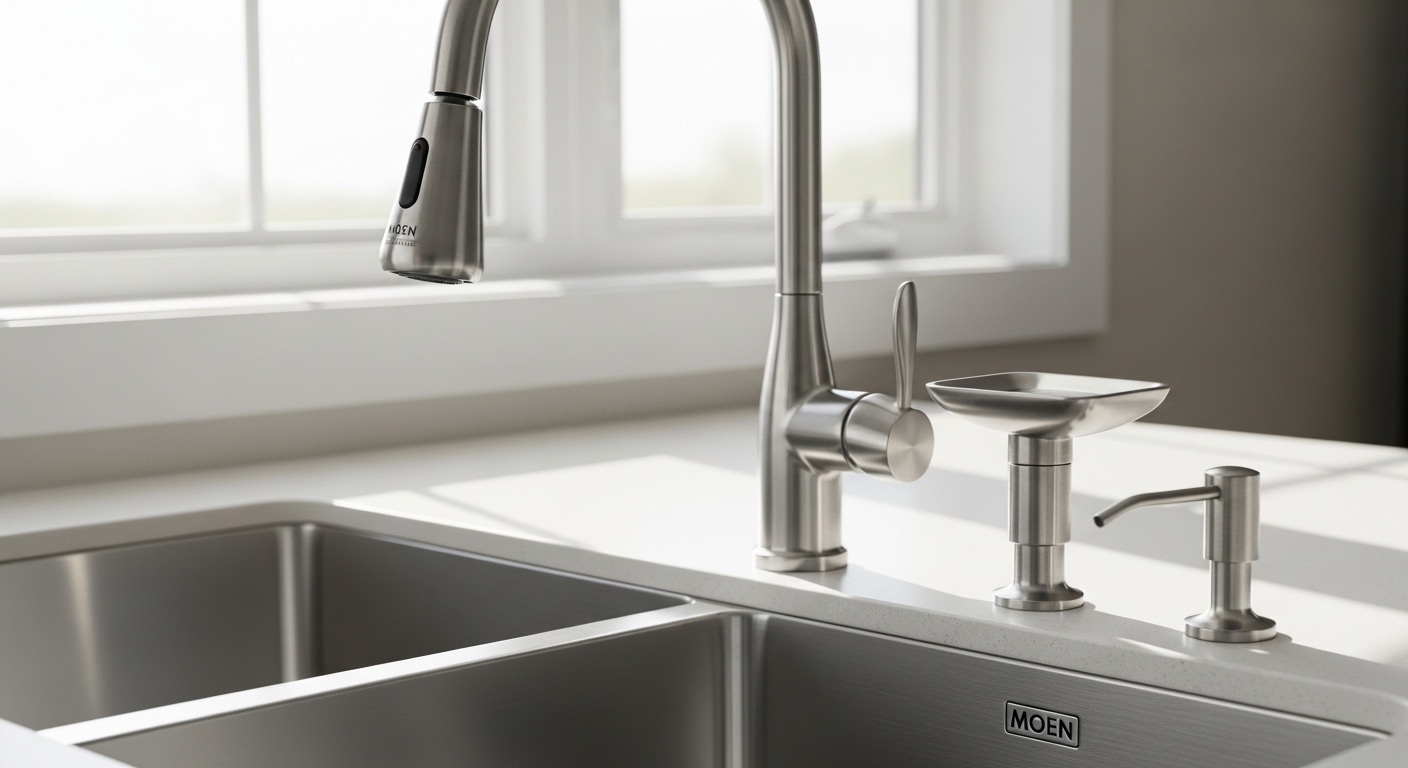
If you’re shopping for a soap dispenser for Moen kitchen faucet setups, the question behind the question is usually one of three things: “Will it match my faucet finish?”, “Will it fit the hole my sprayer or air gap used to live in?”, and “Do I really have to unscrew the bottle from underneath every single time it runs out?” Good news — all three are solvable, and you don’t have to spend $90 on a branded accessory to get it right. Below I’ll walk you through exactly what fits a Moen faucet, which finishes match, how top-fill versus bottom-fill changes daily life, and how to install one in about ten minutes.
Will any soap dispenser fit a Moen kitchen faucet sink?
Yes — almost any deck-mounted soap dispenser fits, because soap dispensers don’t actually connect to the faucet at all. They mount into a separate hole in your sink deck or countertop. What matters is the hole diameter and the deck thickness, not the faucet brand. Moen doesn’t use a proprietary mounting system for soap dispensers, so you’re free to mix brands as long as the dimensions line up.
Standard kitchen sink accessory holes are 1.25 to 1.5 inches (32–38 mm) in diameter. The vast majority of soap dispensers — Moen, WOWOW, and generic — are built for exactly this range and include a rubber gasket and a threaded mounting nut to clamp down from below. If your sink is granite, quartz, or a thick composite, double-check the dispenser’s maximum deck thickness (most handle up to about 1.5–2 inches). For a stainless or fireclay sink, thickness is never an issue.
The most common scenario: you bought a Moen pull-down faucet, which has the sprayer built into the spout, so the old side-sprayer hole is now empty. That hole is the perfect home for a soap dispenser. Same goes for a hole that once held a reverse-osmosis air gap you no longer use. If your sink has no spare hole, you can drill one in stainless steel with a step bit — or far easier, choose a granite/quartz/fireclay sink that you have a pro drill, since DIY-drilling stone risks cracking it.
How do I match a soap dispenser to my Moen faucet finish?
Match the dispenser to the faucet’s exact finish name, not just the color family — “stainless,” “brushed nickel,” and “satin” can look noticeably different side by side. Moen’s most common kitchen finishes are Spot Resist Stainless, Chrome, Matte Black, Oil-Rubbed Bronze, and Spot Resist Brushed Nickel. Buy a dispenser labeled with the same finish term and you’ll get a near-perfect match.
The trickiest pairings are the warm and dark finishes. Spot Resist Stainless has a slightly warmer, softer brushed look than a cool “polished stainless,” so pair it with a brushed/satin-finish dispenser rather than a mirror-polished one. Matte Black is generally safe — true matte black is consistent across brands. Oil-Rubbed Bronze is the riskiest, because ORB is hand-applied and varies from a near-black to a warm coffee-brown; if you can, buy the dispenser and faucet from the same brand or the same coordinating collection.
| Moen Faucet Finish | Best Dispenser Finish to Buy | Match Difficulty | Tip |
|---|---|---|---|
| Spot Resist Stainless | Brushed / Satin Stainless | Easy | Avoid mirror-polished — it looks too cold next to it |
| Chrome | Polished Chrome | Very Easy | Chrome is the most universally consistent finish |
| Matte Black | Matte Black | Easy | Confirm it’s matte, not glossy “piano” black |
| Spot Resist Brushed Nickel | Brushed Nickel | Medium | Slightly warmer than stainless; compare in daylight |
| Oil-Rubbed Bronze | Oil-Rubbed Bronze | Hard | Buy same brand/collection — ORB varies a lot |
One practical move: order your dispenser and look at it next to the faucet under your actual kitchen lighting before you mount it. Finishes that look identical in a product photo can read differently under warm LED bulbs versus daylight. If it’s off, returning an unmounted dispenser is painless; returning one you’ve already clamped to a gasket-sealed hole is not.
Top-fill vs. bottom-fill: which soap dispenser is actually worth it?
Get a top-fill (refill-from-the-top) dispenser — it’s the single biggest quality-of-life upgrade and worth the few extra dollars. With a traditional bottom-fill design, you have to open the cabinet, reach under the sink, unscrew the bottle from the pump, fill it, and screw it back on without spilling. A top-fill dispenser lets you pour soap straight down the spout from above, like topping off a gas tank, in five seconds.
Here’s the honest trade-off. Bottom-fill dispensers are cheaper and have a slightly larger reservoir because the whole under-sink bottle is the tank. Top-fill dispensers cost a little more and the mechanism is marginally more complex. But anyone who has refilled a bottom-fill dispenser twice will tell you the convenience wins every time — especially in a busy kitchen where the dispenser empties weekly.
- Top-fill: Refill from above in seconds, no cabinet diving, slightly pricier. Best for most people.
- Bottom-fill: Cheaper, bigger reservoir, but you refill from under the sink. Fine if it’s rarely used.
- Pump material: Choose a metal or metal-look pump head over thin plastic — it holds finish longer and resists soap corrosion.
- Bottle material: Look for a glass or thick HDPE bottle; flimsy bottles crack when over-tightened.
- Spout reach: Make sure the spout clears your sink edge so soap drips into the basin, not onto the deck.
Whatever you pick, fill it with hand soap or dish soap — not thick lotions, exfoliating scrubs, or foaming soap unless the pump is rated for foam. Gritty or overly viscous liquids clog the pump’s check valve and shorten its life. If you want foaming soap, buy a dispenser specifically built with a foaming pump; a standard pump can’t aerate liquid soap properly.
Do I need a Moen-branded dispenser, or is a universal one fine?
A universal dispenser in the matching finish is completely fine for the vast majority of kitchens — you’re paying mostly for the name and a guaranteed finish match when you buy Moen-branded. Since the dispenser never touches the faucet’s waterway and mounts independently, there’s no compatibility or warranty issue with mixing brands. The only strong reason to buy the exact Moen accessory is finish certainty on tricky colors like Oil-Rubbed Bronze.
That said, “universal” doesn’t mean “all the same.” A well-made dispenser uses a corrosion-resistant pump, a non-yellowing bottle, and a real metal finish over the pump head rather than painted plastic that chips. This is the same logic that applies to choosing the faucet itself — as we cover in our guide to luxury vs. budget faucets compared, the cheapest option often costs more over time once you factor in replacements. A $12 plastic dispenser that corrodes in a year isn’t a bargain.
| Factor | Moen-Branded Dispenser | Quality Universal (e.g., WOWOW) |
|---|---|---|
| Finish match | Exact, guaranteed | Excellent if you match the finish name |
| Price | $$$ (often $60–$90) | $ (often $15–$35) |
| Top-fill option | Available | Widely available |
| Fits Moen sink hole | Yes | Yes (standard 1.25–1.5″) |
| Warranty | Limited lifetime (varies) | Varies by maker — check terms |
How do you install a soap dispenser on a Moen faucet sink?
Installation takes about ten minutes and needs no plumbing — just a spare sink hole, the dispenser kit, and your hands (maybe pliers). Because the dispenser only mounts into the deck and holds its own soap, there are no water lines to connect. Here’s the full process.
- Clear the hole. If you’re using the old side-sprayer hole, disconnect and remove the sprayer hose from below first. If there’s a hole cover or button plug, pop it out from underneath.
- Separate the dispenser. Unscrew the bottle and the mounting nut from the dispenser body so you have the pump/spout unit, the rubber gasket, the threaded shank, the nut, and the bottle.
- Seat the pump from above. Slide the gasket onto the shank, then drop the shank down through the sink hole from the top so the spout sits where you want it (usually angled into the basin).
- Tighten from below. Reach under the sink, thread the mounting nut onto the shank, and hand-tighten. Snug it with pliers a quarter-turn more — don’t overtighten or you’ll crack the bottle threads or distort the gasket.
- Attach and fill the bottle. For bottom-fill, screw the bottle onto the shank from below and fill it before attaching, or fill via funnel. For top-fill, just pour soap down the spout from above.
- Prime the pump. Press the pump head 10–15 times to draw soap up the tube. The first few pumps will be air; then soap flows.
If you removed an old side sprayer to make room, our walkthrough on how to remove a faucet from under the sink covers the under-cabinet access and disconnection steps in detail — the same techniques apply to pulling a sprayer hose. And if you’re tackling this as part of a bigger upgrade, see how to change a faucet in a kitchen sink so you do the dispenser and faucet in one efficient session.
How do I keep a soap dispenser from clogging or leaking?
Use thin liquid soap, prime the pump after every refill, and snug the mounting nut just enough to compress the gasket — that prevents 95% of clogs and leaks. Most failures come from three things: soap that’s too thick, an air-locked pump, or an over- or under-tightened mount.
If the pump stops drawing soap, it’s almost always a clog in the spring-loaded check valve or the dip tube. Pump warm water through it: fill the bottle with hot (not boiling) water and pump repeatedly to flush dried soap. For a stubborn clog, soak the pump head in warm water with a splash of vinegar for 15 minutes, then flush again. If you’re battling mineral buildup because of hard water, the same descaling logic we explain in how to unclog a kitchen faucet aerator applies to the dispenser pump — hard water leaves the same scale everywhere.
Leaks at the deck almost always mean the gasket isn’t seated flat or the nut backed off. Re-tighten by hand plus a quarter-turn. If soap pools around the base on the countertop, that’s usually drips from the spout, not a leak — angle the spout further over the basin. Wipe the finish dry after refills, especially on Matte Black and Oil-Rubbed Bronze, where dried soap can leave a film over time.
What size and type of soap should I put in it?
Fill it with standard liquid hand soap or thin dish soap, and skip anything thick, foaming, or gritty unless the pump is specifically rated for it. A typical kitchen dispenser bottle holds 12–14 ounces, which lasts a household of four roughly one to two weeks of regular use.
The practical hierarchy: thin liquid soaps (hand soap, standard dish soap) pump flawlessly. Medium-thickness soaps work but pump a little slowly. Thick lotions, moisturizing hand washes with added oils, and exfoliating scrubs clog the check valve and are the number-one cause of premature pump failure. Foaming soap needs a dedicated foaming pump that mixes air into the soap — a standard pump just dispenses watery liquid. When in doubt, dilute a thick soap slightly with water to keep it flowing.
FAQ
Does Moen make a soap dispenser that matches my faucet?
Yes. Moen offers deck-mounted soap and lotion dispensers in its core finishes — Chrome, Spot Resist Stainless, Spot Resist Brushed Nickel, Matte Black, and Oil-Rubbed Bronze — designed to coordinate with their kitchen faucet collections. They’re the safest pick for a guaranteed finish match, though a quality universal dispenser in the same finish name will look nearly identical for a fraction of the price.
Will a soap dispenser fit the old side-sprayer hole on my Moen sink?
Almost certainly yes. Side-sprayer holes and standard accessory holes are both in the 1.25–1.5 inch range, which is exactly what soap dispensers are built for. Just remove the old sprayer hose from under the sink first, then mount the dispenser into the empty hole. It’s the single most common spot people install one after switching to a Moen pull-down faucet.
Can I use any brand of soap dispenser with a Moen faucet?
Yes. Soap dispensers mount into the sink deck independently and never connect to the faucet’s water supply, so brand mixing causes no compatibility or warranty problems. The only thing to match is the finish and the hole size. A well-made universal dispenser in the matching finish performs just as well as a branded one.
Is a top-fill soap dispenser worth the extra cost?
For most kitchens, absolutely. Top-fill lets you refill from above in seconds instead of crawling under the sink to unscrew the bottle. The price difference is usually only a few dollars, and the daily convenience — especially in a high-traffic kitchen that empties weekly — makes it the recommended choice for nearly everyone.
Why is my soap dispenser pump not working?
The most common cause is a clog from thick soap or an air-locked pump after a refill. Flush it by pumping hot water through the bottle, and prime it with 10–15 pumps until soap draws up the tube. For mineral or dried-soap buildup, soak the pump head in warm water with a little vinegar for 15 minutes, then flush again. Switching to a thinner liquid soap prevents repeat clogs.
How long does a kitchen soap dispenser last?
A quality dispenser with a metal pump and a non-yellowing bottle typically lasts five years or more with thin liquid soap and occasional cleaning. Cheap all-plastic dispensers often fail within a year as the pump corrodes or the finish chips. Using the right soap and flushing the pump periodically is the biggest factor in longevity — more so than brand.
The bottom line
For a Moen kitchen faucet, the best soap dispenser is a top-fill, deck-mounted model in your faucet’s exact finish name that fits a standard 1.25–1.5 inch sink hole. You don’t need to buy Moen-branded unless you’re matching a tricky finish like Oil-Rubbed Bronze — a quality universal dispenser in the right finish looks the part, installs in ten minutes with no plumbing, and saves you real money. Match the finish, choose top-fill, fill it with thin liquid soap, and you’ll have a clean, coordinated sink setup that lasts years.
Author note: This guide was written by the WOWOW Faucet product team, drawing on hands-on installation and finish-matching testing across Chrome, Stainless, Matte Black, and Oil-Rubbed Bronze fixtures. WOWOW designs kitchen and bath fixtures that meet cUPC and NSF/ANSI compliance standards, and we back our faucets and accessories with a manufacturer warranty. We test finish durability and pump reliability so the advice here reflects how these products actually perform in a real kitchen — not just spec sheets.