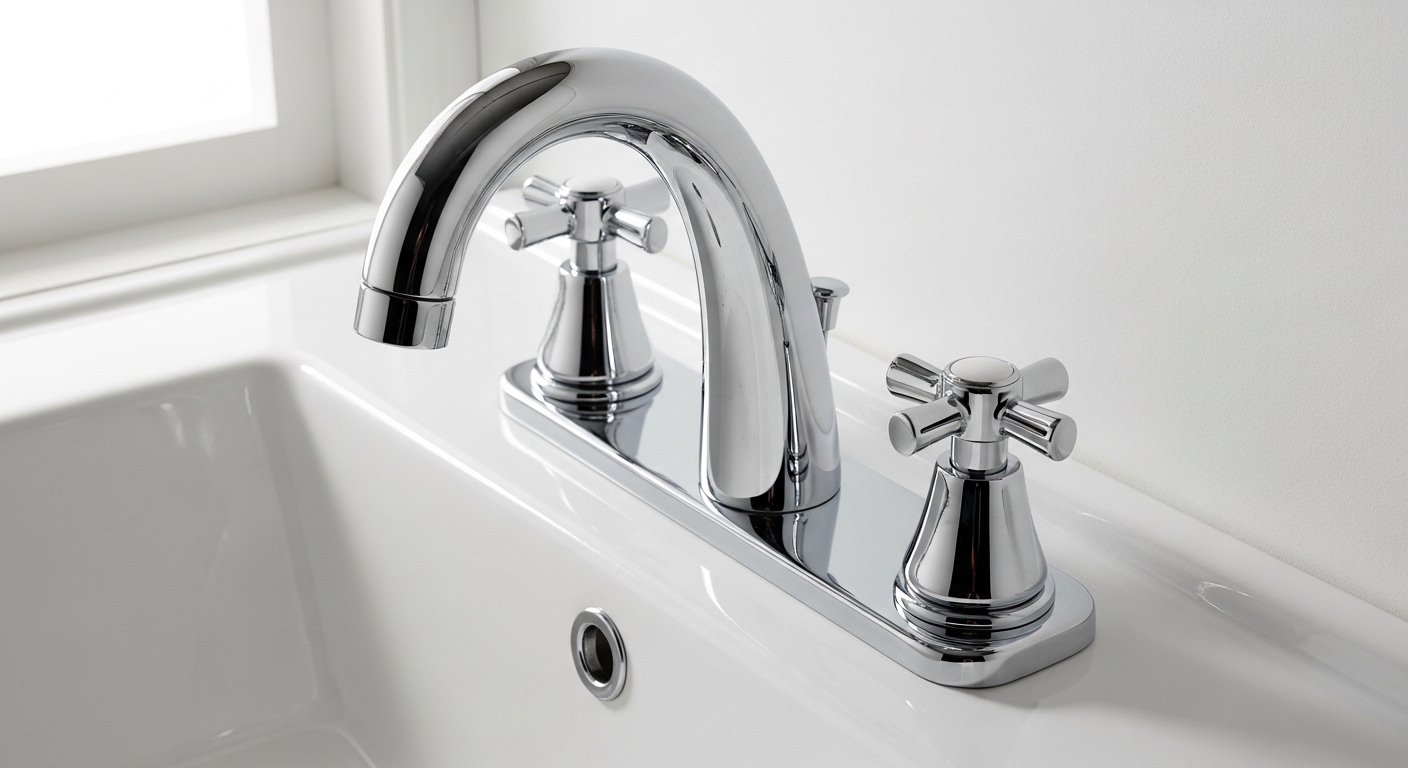
A centerset bathroom faucet chrome model is a faucet where the spout and both handles sit on a single base plate (usually 4 inches wide), finished in bright, mirror-like polished chrome. If your sink has three holes drilled 4 inches apart center-to-center, this is the faucet category built specifically for you — and chrome remains the best-selling finish in the U.S. for good reason. Below, we’ll answer the real questions people actually ask before buying one, including how it differs from a single-hole or widespread faucet, whether chrome still looks dated, what you should pay, and how to install it yourself in under an hour.
What exactly is a centerset bathroom faucet, and how do I know my sink needs one?
A centerset faucet combines the spout and two handles on one connected base plate, designed for sinks with three holes spaced 4 inches apart (measured center-to-center of the outer holes). To know if you need one, flip up your sink or look underneath: if you see three holes and the outer two are 4 inches apart, a centerset is your match.
This is the single most common configuration in American bathrooms, especially in homes and apartments built or remodeled in the last 40 years. The “centerset” name simply means everything is grouped at the center on that 4-inch deck. Don’t confuse it with two other layouts:
- Single-hole faucet: One hole only; spout and handle are a single unit. Some centersets come with an optional deck plate (escutcheon) to cover unused holes, but a true single-hole faucet won’t cover a 4-inch three-hole sink.
- Widespread faucet: Three separate pieces (spout plus two independent handles) for holes spaced 8 to 16 inches apart. This is for larger vanities and a more upscale look — but it will not fit a 4-inch sink.
- Mini-widespread: A hybrid that looks like a widespread (separate-looking pieces) but fits the same 4-inch spread as a centerset.
So the rule is simple: 4-inch spread = centerset (or mini-widespread). Measure first, buy second. Getting the spread wrong is the number-one reason faucets get returned.
Is chrome still in style in 2026, or does it look dated?
Chrome is absolutely still in style in 2026 — it’s a timeless neutral, not a trend, and it’s the most forgiving finish for resale and mixed-decor bathrooms. While matte black and brushed gold have grabbed headlines, polished chrome never disappears because it works with every color palette, fixture brand, and tile choice.
Here’s the honest nuance: chrome reads as crisp, clean, and slightly traditional-to-transitional. If your bathroom is going for a moody, ultra-modern, or warm-organic look, brushed nickel, matte black, or champagne bronze might suit the mood better. But chrome’s bright reflectivity makes small bathrooms feel larger and brighter, and it’s the easiest finish to find matching accessories for. We dig deeper into this in our guide on whether chrome finish is out of style in 2026, and if you’re torn between two classics, our breakdown of polished chrome vs. satin nickel spells out exactly when each one wins.
One practical point most buyers miss: polished chrome actually hides water spots and toothpaste splatter better than matte black or brushed finishes in day-to-day use, because its high reflectivity disguises light streaking. It does show fingerprints up close, but a quick wipe with a microfiber cloth restores the shine instantly — no special cleaners needed.
Centerset vs. widespread vs. single-hole: which should I actually buy?
Buy a centerset if you have a 4-inch three-hole sink and want the easiest, most affordable option; choose widespread only if your sink is pre-drilled for 8-inch spread and you want a higher-end look. The table below makes the trade-offs clear.
| Feature | Centerset (Chrome) | Widespread | Single-Hole |
|---|---|---|---|
| Hole spread | 4 in (three holes) | 8–16 in (three holes) | 1 hole |
| Typical price | $40–$150 | $120–$400+ | $50–$200 |
| Install difficulty | Easy (one base plate) | Moderate (three pieces) | Easiest |
| Best for | Standard/small sinks, rentals, kids’ baths | Large vanities, master baths | Modern minimalist sinks |
| Look | Classic, transitional | Upscale, custom | Sleek, contemporary |
| Cleaning around base | Easy (one deck) | More crevices | Easiest |
For most people replacing an existing faucet in a standard bathroom, a chrome centerset is the smart default — it matches your existing holes, costs the least, and goes in fastest. Save the widespread for a vanity that’s already drilled for it or a full remodel where you’re choosing the sink too. If you’re still weighing how much to spend overall, our comparison of luxury vs. budget faucets shows where extra dollars genuinely buy longevity versus just buying a name.
How much should I pay for a good chrome centerset faucet?
Expect to pay $40–$150 for a quality chrome centerset bathroom faucet that will last 8–15 years; below $30 you risk plastic internals and early leaks, while above $200 you’re mostly paying for brand prestige rather than better function. The sweet spot for durability and value sits around $60–$120.
Here’s what your money actually buys as you move up the price ladder:
- Under $30: Often zinc-alloy or plastic bodies, rubber washers instead of ceramic cartridges. Fine for a rarely used guest bath, but expect drips within a couple of years.
- $40–$80: The value zone. Look for a solid brass body and a ceramic disc cartridge — this combination resists corrosion and drips for a decade or more.
- $80–$150: Brass body, premium ceramic cartridge, better finish bonding, smoother handle action, and often a lifetime warranty.
- $150+: Designer styling, name-brand premium, sometimes touchless tech — diminishing returns on pure function.
The two specs that matter most for longevity are the body material and the cartridge. A solid brass body won’t corrode like cheap zinc, and a ceramic disc cartridge (versus a rubber washer) is what keeps the faucet drip-free for years. If you want to understand which materials truly go the distance, our deep-dive on faucet materials and which last the longest is worth a read before you buy.
What features should I look for in a chrome centerset faucet?
Prioritize a solid brass body, a ceramic disc cartridge, a WaterSense-certified aerator (1.2 GPM or less), and a finish backed by a lifetime warranty against tarnish. These four things separate a faucet you install once from one you replace every few years.
- Ceramic disc cartridge: The heart of the faucet. It controls flow and temperature and is the part that wears out. Ceramic discs are far more durable than rubber compression washers.
- Solid brass construction: Resists corrosion from hard water and lasts decades. Tap the body — brass feels dense and solid, not hollow and light.
- WaterSense label: An EPA program certifying the faucet uses 20% less water (1.5 GPM or below) without sacrificing pressure. It saves money on every water bill.
- Drip-free finish bonding: Quality chrome is electroplated over a nickel undercoat, which prevents flaking and pitting. Cheap chrome skips the undercoat and peels.
- Easy-to-reach handle reach: Two-handle centersets give you precise hot/cold control; single-handle centersets are quicker for one-handed use and kids.
One overlooked factor is your home’s water pressure. A faucet rated for low-flow won’t feel weak if your supply pressure is healthy — but if your pressure is already marginal, an aggressive low-flow aerator can feel like a trickle. It’s worth learning how to check faucet pressure before buying so you choose an aerator rating that still feels satisfying at the tap.
Can I install a chrome centerset faucet myself, and how long does it take?
Yes — installing a centerset faucet is one of the easiest plumbing jobs, taking 30–60 minutes with basic tools and no special skills, because everything mounts on a single base plate. If you can turn a wrench and follow a few steps, you can do this without a plumber.
Here’s the basic process:
- Turn off the water at the shutoff valves under the sink and open the old faucet to release pressure.
- Disconnect the supply lines and remove the old faucet’s mounting nuts from underneath. (If yours is corroded and stuck, a little penetrating oil helps.)
- Clean the sink deck of old putty or gasket residue so the new base plate sits flush.
- Set the new faucet onto the deck — most centersets include a rubber gasket, so plumber’s putty is often optional.
- Tighten the mounting nuts from below, then connect the supply hoses to the shutoff valves.
- Turn the water back on slowly, remove the aerator, run water to flush debris, then reinstall the aerator and check for leaks.
The trickiest part is usually working in the tight space under the sink, not the faucet itself. A basin wrench makes the mounting nuts far easier to reach. If your shutoff valves are old, this is a good time to inspect them, and our guide on how to connect faucet hoses to shutoff valves walks through doing it leak-free the first time.
How do I keep chrome looking shiny and spot-free?
Wipe your chrome faucet dry with a soft microfiber cloth after heavy use, and clean weekly with mild dish soap and water — never use abrasive scrubbers, bleach, or ammonia-based cleaners, which can dull or pit the finish. That’s genuinely all chrome needs.
For stubborn hard-water spots, a 50/50 mix of white vinegar and water on a cloth (not sprayed directly, and not left on long) dissolves mineral buildup. Rinse and dry afterward. Avoid leaving vinegar on the finish for extended periods. Chrome’s biggest enemy isn’t dirt — it’s abrasive pads and harsh chemicals that scratch the protective layer. Treat it gently and a quality chrome finish will stay mirror-bright for the life of the faucet.
FAQ
Will a 4-inch centerset faucet fit my sink?
It fits if your sink has three holes with the two outer holes spaced exactly 4 inches apart, measured center-to-center. This is the standard spread for centerset faucets and the most common bathroom sink layout in the U.S. Always measure before buying — a widespread faucet (8-inch spread) will not fit a 4-inch sink, and vice versa.
Is chrome or brushed nickel better for a bathroom faucet?
Chrome is brighter, more reflective, easier to match with accessories, and usually cheaper; brushed nickel is warmer, hides fingerprints and water spots more easily, and suits transitional or cozy decor. For small or bright bathrooms and budget-conscious shoppers, chrome wins. For homes leaning warm or rustic, brushed nickel often fits better. Neither is “wrong” — it’s about your bathroom’s lighting and palette.
Do centerset faucets come with a deck plate to cover extra holes?
Most centerset faucets are built on a 4-inch base plate that automatically covers all three holes, so no separate deck plate is needed. If you’re switching to a single-hole faucet on a three-hole sink, you’d need a separate escutcheon plate — but a standard centerset already handles this by design.
How long does a chrome centerset bathroom faucet last?
A quality chrome centerset faucet with a solid brass body and ceramic disc cartridge typically lasts 8–15 years, and the chrome finish itself can last the full lifetime of the faucet if cleaned gently. Cheaper models with plastic internals or rubber washers may start dripping within 2–3 years, which is why the body material and cartridge matter more than the price tag alone.
Can I replace just the handles on a two-handle chrome centerset faucet?
Yes, handles are usually replaceable as long as you match the brand and model, since they attach to the cartridge stem with a set screw. If a handle is loose or cracked, you often only need a new handle or cartridge rather than a whole new faucet. Keep your faucet’s model number handy — it makes ordering the right replacement part much easier.
Does a chrome finish show water spots more than matte finishes?
Chrome shows fingerprints up close, but its high reflectivity actually disguises light water streaking better than matte black or some brushed finishes in everyday use. A quick wipe with a dry microfiber cloth keeps it spotless. Matte finishes don’t show fingerprints but can show dried mineral residue more visibly, so each has a trade-off.
The bottom line
If you have a standard 4-inch three-hole bathroom sink, a chrome centerset faucet is the most practical, affordable, and timeless choice in 2026. Spend in the $60–$120 range, insist on a solid brass body and ceramic disc cartridge, look for a WaterSense label and a lifetime finish warranty, and you’ll have a faucet that looks great and stays drip-free for over a decade. If your decor leans warm or ultra-modern, explore other finishes — but for fit, value, and easy maintenance, chrome centerset is hard to beat. Still deciding on overall style direction? Our guide to modern vs. vintage bathroom faucets can help you lock in the look before you buy.
About the author: This guide was written by the product team at WOWOW Faucet, drawing on hands-on testing of centerset, widespread, and single-hole faucets across hundreds of real bathroom installations. As a dedicated faucet and bathroom-fixtures brand, WOWOW designs and tests its products to meet U.S. cUPC and WaterSense standards, builds with solid brass and ceramic disc cartridges, and backs its finishes with a limited lifetime warranty against corrosion and tarnish. Our recommendations are based on durability testing, real-world install feedback, and published plumbing standards — not marketing claims.