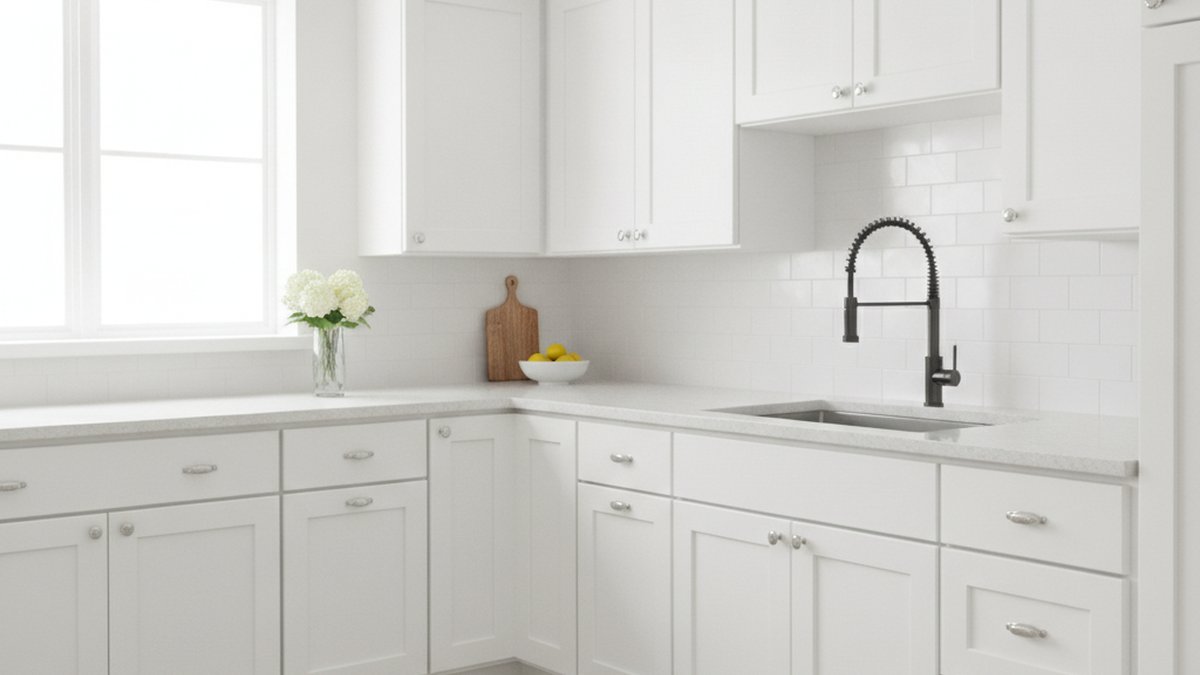
A black kitchen faucet with white cabinets works because it uses the oldest trick in design: strong contrast. White cabinets read as a clean, bright backdrop, and a black faucet becomes a deliberate focal point above the sink rather than something that blends into the countertop and disappears. It’s the same reason black window frames and black hardware exploded in popularity — dark metal against white reads as crisp and confident. The short version: it looks good, it photographs well, and it’s about as safe as a “bold” choice gets.
But “will it look good” isn’t really the question people are asking. They’re asking whether it will still look good after the trend cools, whether matte black shows every water spot, whether it clashes with their brushed-nickel cabinet handles, and whether a $90 black faucet will chip and peel in two years. Those are the real questions, and that’s what the rest of this guide answers — concretely, with specs and scenarios.
Will a Black Faucet with White Cabinets Look Dated in a Few Years?
No — high-contrast black-and-white is one of the least trend-dependent combinations you can pick, so it ages far better than colored or highly specific finishes. Black is technically a neutral, and white cabinets are the single most classic cabinet color in American kitchens. Pairing two neutrals almost never “goes out of style” the way, say, oil-rubbed bronze or a specific shade of beige can.
Here’s the nuance that actually matters. What dates a kitchen is rarely the color — it’s the shape and the finish quality. A bulbous, over-styled faucet from 2010 looks dated in black or chrome. A clean, simple gooseneck or a straight commercial-style spring faucet looks current in almost any finish. So if you want longevity, spend your attention on silhouette first, then finish.
The other longevity factor is coating durability. A cheap painted black faucet can fade to a chalky gray or peel around the spray head, and that is what makes people regret the choice — not the color itself. Look for PVD (physical vapor deposition) or a genuine baked matte finish rather than a sprayed-on paint, and you avoid 90% of the “I hate my black faucet now” complaints you’ll read on Reddit.
Matte Black vs. Glossy Black: Which One Should You Buy for White Cabinets?
Choose matte black in almost every case — it’s softer, hides water spots and fingerprints far better than gloss, and is the finish that actually reads as “modern.” Glossy (or “shiny”) black looks sleek in a showroom but shows every dried water droplet and smudge under kitchen lighting, which is brutal next to bright white cabinets that reflect a lot of light onto the fixture.
That said, the two finishes send different design messages against white:
- Matte black — soft, contemporary, farmhouse-friendly, and forgiving on maintenance. This is the default recommendation for white shaker cabinets and the most popular choice overall.
- Glossy / polished black — dramatic and a little more formal or “European modern.” Best in flat-panel or high-gloss white cabinets, but be honest with yourself about how often you’ll wipe it down.
- Black stainless / gunmetal — technically a warmer, slightly metallic dark finish. A middle ground if pure black feels too stark against your particular white.
One practical detail people forget: matte black hides water spots but can show dried mineral scale as a whitish film if you have hard water. A quick daily wipe with a soft cloth prevents it. If your water is very hard, read our guide on removing hard water deposits from a faucet head so buildup never gets a chance to dull the finish.
What’s the Best Type of Black Kitchen Faucet for a White Kitchen?
For most white kitchens, a matte black pull-down faucet with a tall gooseneck is the best all-around choice — it gives you the dramatic contrast, easy sink cleanup, and a silhouette that suits everything from farmhouse to modern. But the right style depends on your sink and how you cook.
Here’s how the common types stack up specifically against white cabinets:
| Faucet Type | Best For | Look Against White Cabinets | Typical Price (Black Finish) |
|---|---|---|---|
| Pull-down gooseneck | Deep single-bowl sinks, everyday cooking | Bold vertical focal point; most versatile | $90–$300 |
| Pull-out (shorter spout) | Low-clearance windows above sink | Sleeker, lower profile; understated contrast | $80–$250 |
| Commercial / spring-coil | Big-batch cooking, filling stockpots | Strong industrial statement; very on-trend | $150–$450 |
| Bridge faucet | Farmhouse & traditional white kitchens | Classic, symmetrical, vintage charm | $200–$600 |
| Touchless / motion-sensor | Busy households, hygiene-focused cooks | Clean modern lines; hides no-touch tech well | $180–$450 |
If you have a window right behind the sink, measure your clearance before you fall in love with a tall spring-coil faucet — those can be 24 inches or taller and will block a low sill. A pull-out or a mid-height gooseneck is the safer pick there. For a broader look at what’s genuinely worth buying this year, see our roundup of the best kitchen faucets 2026 has to offer for different budgets and sink setups.
Should the Faucet Match the Sink, or Contrast With It?
Either works, but a black faucet over a white or stainless sink gives you the cleanest contrast, while a black faucet over a black or dark granite composite sink creates a sleek, monochrome “column” look. Against white cabinets specifically, the two most photographed combinations are: black faucet + white farmhouse sink (classic, high-contrast) and black faucet + stainless undermount (modern, low-maintenance). A black-on-black sink-and-faucet pairing looks fantastic but shows water scale the most, so factor in your cleaning tolerance.
Will a Black Faucet Clash with My Nickel or Chrome Cabinet Hardware?
It can look accidental if your cabinet handles are bright chrome or polished nickel and nothing else in the room repeats the black — but it’s easy to fix, and mixing metals is completely acceptable in modern design as long as you do it on purpose. The goal is to make the black look intentional, not like the one thing you forgot to match.
Three reliable ways to tie it together:
- Repeat the black at least twice. Add black cabinet pulls, black pendant lights, black bar stools, or black window frames. The eye reads two or more black elements as a deliberate scheme.
- Add a black soap dispenser or a matching black filtered-water tap. This is the cheapest, fastest fix and it sits right next to the faucet where the “match” matters most.
- Let the faucet be the single dark accent. If everything else is warm brass or brushed nickel, one black faucet can still work as a deliberate two-metal pairing — just keep the metals consistent within each “zone” (e.g., all hardware brass, faucet black).
The one combination to avoid is a lonely black faucet in a room where every other metal is a different warm tone with no repetition anywhere. That’s when it reads as a mismatch rather than a mix.
Is a Cheap Black Kitchen Faucet Worth It, or Will the Finish Peel?
A budget black faucet is fine if the black comes from a PVD or baked-on finish rather than sprayed paint — those hold up for years. The faucets people regret are the ultra-cheap ones with a painted coating that chips at the spray head, fades to gray, or peels where your hand grips it. Finish technology, not price alone, is what predicts whether it lasts.
What to look for on the spec sheet or product page:
- PVD or “spot-resist” matte black finish — bonded at a molecular level, highly scratch- and corrosion-resistant.
- Solid brass body (not zinc alloy) — better durability and less chance of internal corrosion. Curious whether brass is worth paying for? Our breakdown of whether a brass faucet build is actually worth it applies to kitchen faucets too.
- Ceramic disc cartridge — the part that prevents drips; far more durable than rubber-washer valves.
- A real warranty — reputable brands back the finish and function with a limited lifetime warranty for residential use. That warranty is your best signal that the manufacturer trusts the coating.
If your existing black faucet already has a small chip or scratch, you don’t necessarily need to replace it — see whether faucet touch-up paint actually works for minor cosmetic fixes before you spend on a new fixture. And if you’re comparing specific budget brands, our honest Forious kitchen faucet reviews walk through what you actually get at the lower price points.
How Do You Keep a Matte Black Faucet Looking New?
Wipe it dry with a soft microfiber cloth after heavy use and clean it with only mild soap and water — never abrasive pads, vinegar-heavy solutions, or bleach, which can dull or strip a matte finish over time. Matte black is genuinely low-maintenance on fingerprints, but its enemy is dried hard-water scale and harsh cleaners.
A simple routine that keeps it looking showroom-fresh:
- Daily: a quick dry wipe after doing dishes to prevent water spots.
- Weekly: mild dish soap on a soft cloth, then dry.
- As needed: for stubborn mineral film, use a cloth dampened with a diluted vinegar solution only briefly, then rinse and dry immediately — don’t let acid sit on the finish.
If the spray head starts spitting or the flow weakens, that’s mineral buildup in the aerator, not a finish problem. Our step-by-step on how to clean a kitchen faucet head when it’s clogged or spitting fixes it in a few minutes without harming the black coating.
What About Resale — Do Buyers Like Black Faucets with White Cabinets?
Yes — white cabinets are the most broadly appealing cabinet color to buyers, and a black faucet reads as an updated, current fixture rather than a personal quirk, so the combination is resale-safe. Unlike a bold cabinet color or an unusual countertop, a black faucet is a small, easily-swapped item, so even a buyer who somehow disliked it wouldn’t count it against the kitchen the way they would a permanent finish.
Because white-and-black is neutral, it also gives buyers a blank slate they can style however they want. That flexibility is exactly what makes it a smart choice if you might sell within a few years — you get a design-forward look now without narrowing your future buyer pool.
How to Choose Your Black Faucet in 5 Steps
If you want a shortcut, here’s the decision path that avoids the most common regrets:
- Measure your clearance. Check the height available under any window and the reach to your sink center before picking a spout style.
- Pick matte over gloss unless you love polishing fixtures daily.
- Confirm the finish is PVD or baked-on, the body is solid brass, and there’s a ceramic disc cartridge.
- Plan one or two more black touches (pulls, pendant, soap dispenser) so the faucet looks intentional.
- Check the warranty — a limited lifetime warranty on finish and function signals a coating that lasts.
Do those five things and a black kitchen faucet with white cabinets becomes one of the lowest-risk upgrades in your whole kitchen — high impact, modest cost, and a look that holds up.
FAQ
Do black faucets show water spots more than chrome?
Matte black actually hides fingerprints and light water spots better than polished chrome. Its real weakness is dried hard-water mineral scale, which can leave a faint whitish film — but a quick dry wipe after use prevents it entirely. Glossy black, on the other hand, shows spots more than chrome, which is why matte is the better everyday choice.
What color hardware goes best with a black faucet and white cabinets?
Black cabinet hardware is the safest, most cohesive match, followed by matte gold/brass for a warm two-tone look that’s very popular right now. Brushed nickel and chrome can work too, but you’ll want to repeat black somewhere else in the room — pendant lights, stools, or a soap dispenser — so the faucet doesn’t look like an accident.
Is matte black or black stainless better for a kitchen faucet?
Matte black gives you the truest, boldest contrast against white cabinets and is the more popular, modern look. Black stainless is a slightly warmer, more metallic dark finish that’s a good compromise if pure black feels too stark next to your particular shade of white or your stainless appliances.
Will a cheap black faucet’s finish peel or fade?
Only if it’s a sprayed-on painted finish. A black faucet with a PVD or baked-on matte finish and a solid brass body resists chipping, fading, and corrosion for years, and reputable versions are backed by a limited lifetime warranty. Check for those specs rather than judging by price alone.
Can I mix a black faucet with a stainless steel sink and appliances?
Absolutely — a black faucet over a stainless undermount sink is one of the most practical, low-maintenance combinations for a white kitchen, and stainless appliances read as a neutral that doesn’t clash with black. To make it feel deliberate, echo the black in your cabinet hardware or lighting.
Does a black faucet make a small white kitchen look smaller?
No. Because the cabinets and walls stay bright white, the room still feels open; the black faucet simply adds one crisp focal point over the sink. If anything, a single dark accent gives a small all-white kitchen visual interest it would otherwise lack. Just avoid piling on too many heavy black elements in a tight space.
Author note: This guide was written by the WOWOW Faucet product team, drawing on hands-on testing of pull-down, pull-out, and commercial-style faucets across matte black, glossy black, and black stainless finishes. WOWOW designs and manufactures kitchen and bathroom fixtures built with solid brass bodies, ceramic disc cartridges, and durable PVD/spot-resist finishes that are independently tested to meet cUPC and industry lead-free standards, and our residential faucets are backed by a limited lifetime warranty on finish and function. We recommend finishes based on real-world durability and maintenance, not just showroom looks.